

St. Louis tornado recovery has drawn sharp public criticism for moving too slowly. City officials argue the scale of damage — 10,000 properties, $1.6 billion in losses — far exceeds any city’s capacity to handle alone. Key delays stem from federal funding timelines, state procurement rules, and limited municipal staffing.
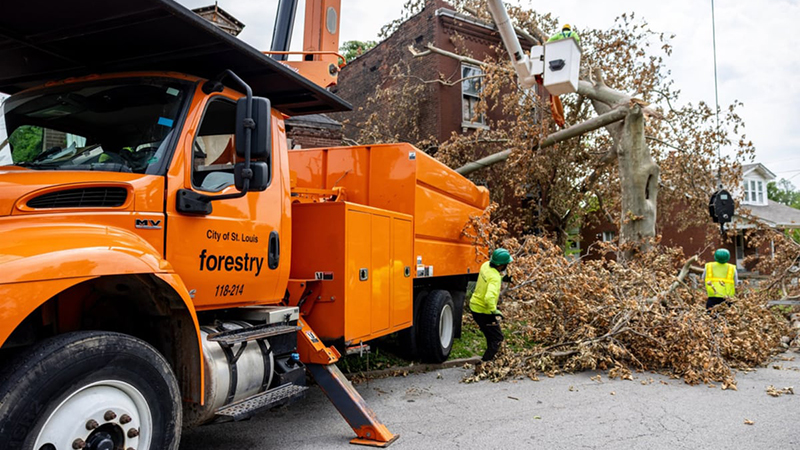
The Question Everyone Is Asking About St. Louis Tornado Recovery
St. Louis tornado recovery is at the center of an urgent public debate: is the city moving fast enough, or is it failing the thousands of residents whose lives were upended by one of the most destructive storms in the region’s modern history?
Investigative reporter Elliott Davis of KDNL-TV put the question directly to Mayor Cara Spencer: “You will agree with me that this entire process has been moving too slow.”
Her answer — and the data behind it — reveals a recovery effort trapped between unprecedented damage, a federal system that has shifted responsibility onto cities, and a funding pipeline that moves far slower than anyone affected can afford to wait.
What the Damage Actually Looks Like
The tornado that tore through the Central West End, North St. Louis, and into Illinois left a trail of destruction that few American cities have faced at this scale.
- ~10,000 properties damaged across the affected corridor
- $1.6 billion in estimated total damage
- 3,000+ applications submitted for home repair assistance alone
- 65 properties flagged for immediate demolition
- 120+ properties in the demolition pipeline as of May 2026
The cost just to repair the homes of applicants in the city’s program exceeds $150 million. That figure doesn’t include commercial buildings, infrastructure, or properties whose owners never applied for help.
Mayor Spencer’s Defense: No City on Earth Was Ready
Why City Hall Says the Pace Is Justified
Mayor Cara Spencer pushed back forcefully when Elliott Davis pressed her on recovery speed. Her core argument: no city anywhere was built to repair thousands of privately owned buildings after a single disaster event.
“No city on planet earth is prepared to repair thousands of privately owned buildings,” Spencer told Davis. “And to suggest that we should have been prepared to do that is ludicrous.”
She pointed to a structural shift that has quietly reshaped how disasters are managed in America. The federal government has moved responsibility away from entities like the Army Corps of Engineers and placed it on cities that, in many cases, had only a handful of staff dedicated to emergency response before the tornado hit.
The Rams Settlement: The Only Flexible Money in the Room
Spencer identified one source of funding as the key to moving any faster in the near term: money from the St. Louis Rams relocation settlement.
A bill introduced in May 2026 would direct $110 million of those settlement funds specifically toward tornado recovery in North St. Louis. Unlike federal and state dollars, Rams settlement funds are not tied to procurement rules, federal reporting requirements, or matching formulas.
“The only thing saving us right now is having the Rams dollars to be able to deploy in a way that is unfettered,” Spencer said. She warned, however, that spending those funds before knowing what federal and state governments will cover “would be irresponsible.”
Alderman Aldridge: “No, I’m Not Satisfied”
A City Leader Who Won’t Sugarcoat the St. Louis Tornado Recovery Delays
Alderman Rasheen Aldridge, chairman of the Aldermanic Budget Committee, gave a blunter assessment when Elliott Davis asked the same question about the pace of recovery.
“No,” Aldridge said flatly.
He acknowledged that no city could have been fully ready for a tornado of EF3-to-EF4 intensity cutting through dense urban neighborhoods. But he made clear that the slow pace has real human consequences — and that multiple levels of government share the blame.
“We’ve been waiting on state funding to come down. We’ve been waiting for FEMA to reimburse us. We’ve been hoping leaders in Congress would be advocating,” Aldridge said.
He also called out the Trump administration directly. When asked if he was satisfied with the federal response, his answer was the same: “No.”
Where the Money Is — and Why It Hasn’t Arrived
Mapping the Funding Gap in St. Louis Storm Recovery
Here is a clear breakdown of the funding sources, what has been committed, and where delays exist.
| Source | Amount Committed | Status / Delay |
|---|---|---|
| FEMA Individual Assistance | ~$50.2 million | Disbursed to residents |
| FEMA Debris Removal Reimbursement | 75% of eligible costs | Ongoing; slow processing timeline |
| State of Missouri (debris match) | 25% of eligible debris costs | Ongoing |
| State Legislature Appropriation | $100 million | Appropriated; spending delayed by procurement rules |
| SBA Low-Interest Loans | ~$27.6 million approved | Available to qualifying businesses and homeowners |
| Rams Settlement Funds (proposed) | $110 million | Pending legislation as of May 2026 |
| Tetra Tech Consultant Contract | $10.6 million | Increased from original contract; managing recovery process |
The pattern is consistent: money exists on paper but moves slowly through compliance, bidding, and reimbursement processes. Federal funds, in particular, can take a year or more to fully flow to local municipalities — a timeline that feels abstract to residents living in damaged or demolished homes.
What the Recovery Plan Actually Looks Like
Phase by Phase: The Tornado Rebuilding Timeline for St. Louis
The city’s current approach follows a “stabilization first” strategy. The goal is to stop further deterioration before full-scale repairs begin.
Current Phase (2025–2026): Stabilization
- Debris removal
- Weatherproofing of damaged structures
- Structural assessments
- Demolitions of condemned properties
Next Phase (Mid-2027 and beyond): Full-Scale Repairs
- City officials have stated that comprehensive rebuilding will not begin until mid-2027
- This timeline depends on state and federal funding being released and administered
Neighborhood-Level Action
- Kingsbury Place has advanced a Community Improvement District (CID) plan to self-assess taxes, generating approximately $6 million for local infrastructure repairs
- This model represents a hyperlocal workaround to the broader funding delays
State Incentives (May 2026 Legislation)
- New state legislation offers tax credits of up to 25% for private investors converting older buildings in downtown and North St. Louis into residential spaces
- This incentivizes private capital without creating direct equity arrangements in public recovery infrastructure
The Federal Responsibility Debate
Has Washington Shifted Too Much Onto Cities Like St. Louis?
One of the most pointed arguments Mayor Spencer made is also one of the most consequential questions facing American disaster policy.
She framed it this way: “What do we want our federal government to do? Do we want cities to hold this responsibility? Is it possible? Should your municipality suddenly be materializing programs to repair thousands of buildings that don’t have insurance?”
The answer, she argued, is clearly no — and the St. Louis tornado recovery is now a real-world case study in what happens when federal responsibility shrinks and local capacity hasn’t grown to match it.
Alderman Aldridge echoed that frustration, noting that cities like St. Louis are left waiting while federal bureaucracy runs its course, even as residents face displacement, continued weather exposure in damaged homes, and an uncertain timeline to anything resembling normal.
Key Takeaways: St. Louis Tornado Recovery at a Glance
- Scale: 10,000 properties damaged, $1.6 billion in losses — larger than most U.S. cities have faced
- Speed: Full-scale repairs won’t begin until mid-2027; the current phase is stabilization
- Money: Over $178 million in FEMA and SBA funds distributed; $100 million in state funds moving slowly; $110 million in Rams funds proposed but not yet released
- Accountability: Both the mayor and a senior alderman acknowledge the pace is not fast enough — but disagree on where the fault lies
- Systemic issue: The federal government’s reduction of direct disaster management has placed an unmanageable burden on cities
What Comes Next for Tornado Recovery in St. Louis
The path forward depends on three things happening simultaneously: the Rams settlement legislation passing and funds being deployed quickly, the state releasing its $100 million appropriation without further procurement delays, and federal reimbursements continuing to flow for eligible debris and emergency costs.
For residents still waiting, the timeline to mid-2027 is not an abstraction — it’s another year of uncertainty. Alderman Aldridge’s call for stronger congressional advocacy and Mayor Spencer’s argument for rethinking federal disaster responsibility both point to the same conclusion: St. Louis cannot rebuild alone, and the systems meant to help it aren’t moving fast enough.
Connect to The Narrative Matters covering federal disaster policy shifts or municipal accountability — for example, an article examining how FEMA funding has changed under recent federal budgets, or a local government accountability story from the St. Louis area.
Learn more: Visit the official FEMA disaster declaration page for the St. Louis tornado @“Missouri’s $100 million tornado recovery appropriation“ — Missouri’s official legislative tracking system.
#StLouisTornadoRecovery #StLouis #DisasterRecovery