

St. Louis Reinforces Its Position as a Leading Global Freight Hub in 2025
[ST. LOUIS, MO/Jan. 8, 2026] The St. Louis region further solidified its standing as a premier national and global freight hub in 2025. This success was propelled by continuing infrastructure investments, robust industrial expansion, and collaborative workforce initiatives.
The St. Louis Regional Freightway’s annual compilation summarizes the year’s most significant milestones. These achievements have advanced the region’s multimodal connectivity and expanded its industrial real estate pipeline. Furthermore, they have supported the growth of the talent pipeline across key industry sectors.
“Our commitment to workforce development and multimodal connectivity ensures that the St. Louis region remains a resilient, world-class hub for freight, manufacturing, and aviation,” said Mary Lamie. She serves as Executive Vice President of Multimodal Enterprises for Bi-State Development and heads its St. Louis Regional Freightway enterprise. “These advancements benefit not only our region but the entire national supply chain.”
Infrastructure Investments and Priority Projects
The release of the 2026 Priority Projects List marked a new high. The list features 29 projects totaling nearly $8.9 billion in investments.
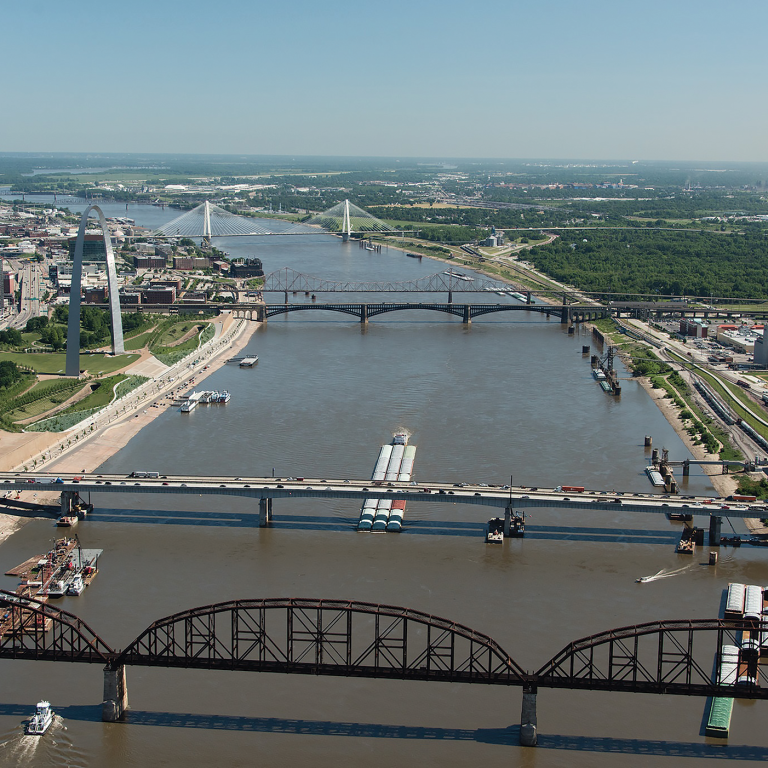
Projects range from the construction or rehabilitation of critical interstates and roads to rail infrastructure and bridges. Additionally, there are enhancements to port and airport facilities. As of May 2025, more than $560 million in projects were completed. Moreover, $2.6 billion in funding had been allocated for others. This includes major upgrades to Interstates 70, 270, and 55. It also covers vital Mississippi River crossings, such as the Chain of Rocks Bridge and MacArthur Bridge.
These projects were identified through a nationally recognized collaborative process. This process highlights the top infrastructure needs of the manufacturing and logistics industries in eastern Missouri and southwestern Illinois. Consequently, these projects are enhancing multimodal connectivity and supporting the region’s positioning as the Ag Coast of America.
Port and Rail System Efficiency
The St. Louis region maintained its top spot as the nation’s most efficient inland port. It moves nearly four times the average tons per river mile compared to other U.S. inland port districts.
Investments in port and rail infrastructure have strengthened the region’s competitive edge for shippers and carriers. This includes new at-grade rail crossings and expanded intermodal capacity. Dan Lester, SVP of Business Development for the Infrastructure Group at Ingram, notes the importance of efficiency. He says it is increasingly vital in today’s environment because barges are very expensive to build. Furthermore, the number of existing barges being retired continues to increase.
Ingram is the leading carrier on the inland waterways. They operate eight facilities along the Missouri and Illinois banks of the Mississippi River in the St. Louis region.
The Value of Efficiency
“How do you increase capacity without spending additional capital? You move to the more efficient operations like St. Louis,” said Lester. “For us to be able to operate efficiently and create more capacity for our customers, we want to see product moving to areas where we can get them to a dock, unloaded and reloaded as quickly as possible. The value of the St. Louis region is based on efficiency.”
Industrial Real Estate Expansion
The pipeline of rail-served industrial sites grew to 26 locations, now totaling almost 5,500 acres. Four new sites in Southwestern Illinois were added. These offer developers heavy industrial zoning, multimodal access, and proximity to major interstates and utilities.
These sites are ideal for end-users seeking to leverage the region’s global connectivity. They offer access to six Class I railroads and rail infrastructure that continues to attract new investment.
“Rail distribution continues to grow in importance, and the St. Louis region is already recognized as one of the largest rail hubs in the nation,” said Brent Wood. Wood is President of the Terminal Railroad Association of St. Louis and Chair of the St. Louis Regional Freightway’s Freight Development Committee. “Rail service and infrastructure in the St. Louis region are constantly improving, thanks to the commitment of public and private leaders who are collaborating to identify priority projects and advocate for funding for them.”
FreightWeekSTL 2025 Delivers
For the seventh consecutive year, the Freightway hosted the weeklong FreightWeekSTL conference. It featured virtual panel sessions with industry experts and leaders in freight, logistics, and transportation. There were also various other in-person networking opportunities.
The wealth of information delivered highlighted innovations, investments, and collaborations shaping the freight and logistics industries. Moreover, it underscored the St. Louis region’s strategic location.

Work-underway-on-Chain-of-Rocks-Bridge-Credit-MoDOT
Highlighting Economic Output
The event also featured the release of the 2025 St. Louis Regional Industrial Real Estate Market Indicators & Workforce Statistics Report. This report highlighted how the St. Louis region is outpacing peers in economic output, fueling industrial expansion.
The report called attention to a 33% GDP surge in recent years in the key sectors of manufacturing and distribution. It also noted a labor force outperforming national averages. It referenced analysis showing that, over the past 10 years, for every new resident arriving in the St. Louis MSA, the overall economy added more than $2.3 million to its GDP.
The statistics show that the region produces higher value goods per person than peer regions across the Midwest. Ultimately, this showcases the value proposition of the St. Louis regional manufacturing and distribution workforce.
Targeted Industry Growth
The report and other materials released by the Freightway during the year highlighted major investments in the organization’s targeted industry sectors. This includes recent project announcements in the Advanced Manufacturing, Chemicals, Food & AgTech, and Metals sectors.
These announcements total more than $3 billion in investment. Consequently, these investments are adding almost 2,000 new jobs in eastern Missouri and southwestern Illinois. They are helping to support the retention of hundreds more. Furthermore, they are creating more than 1,000 construction jobs.
Those numbers don’t include previously reported investments in the aerospace manufacturing and services sectors. In the St. Louis region, aerospace manufacturing is a thriving industry contributing to economic vitality. It boasts a job concentration nearly four times the national average. Additionally, average annual wages are 2.10 times the regional average.
Aerospace and Aviation Leadership
The Freightway’s Aerospace & Aviation Task Force continued its collaborative efforts to grow the workforce. More than $5 billion in recent, current, and planned investments are creating new jobs across the bi-state area.
These efforts included the launch of a new Careers Roadmaps initiative. This program is aimed at helping area high school students and new career seekers. It helps them navigate their way to an exciting future in aerospace or aviation.
Mapping Future Careers
The Roadmaps highlight sample careers in these vibrant industries. They also detail earning potential for these positions in the St. Louis region. Notably, the median salaries tend to be higher than the national average.
The Roadmaps provide insight on what individuals need to do to become an aerospace or aviation professional. Along with related information on educational and training programs and job openings in the bi-state area, the Roadmaps are now accessible online at www. AeroSTL.org/Jobs.
Summits and Forums
The inaugural Global Aerospace Summit and the fourth annual Take Flight Forum further showcased the region’s strengths. They highlighted future growth in aerospace and aviation.
Additionally, they focused on training programs and partnerships with local schools, colleges, and industry leaders. These partnerships are preparing the next generation for high-paying careers in the region’s vibrant aerospace and aviation ecosystem. The region’s airports also reported record passenger growth and major capital investments.
“2025 was about building connections, advancing infrastructure priorities, and strengthening the St. Louis region’s freight network,” Lamie said. “We brought industry, education and opportunity together and, working collaboratively, we’re shaping the future of our region and building capacity for what’s next in 2026 and beyond.”
About St. Louis Regional Freightway
Established as the St. Louis region’s authority for coordinating support for industrial businesses and the logistics infrastructure they depend on, the St. Louis Regional Freightway (the Freightway) provides site selection and business assistance to manufacturing, logistics and multimodal transportation companies and their service providers. As an enterprise of Bi-State Development, the Freightway partners with public sector and private industry businesses to advocate for infrastructure development that supports the movement of freight, leads initiatives to grow the region’s talent pool, and plays a critical role in marketing the region as a world-class manufacturing and distribution cluster within the City of St. Louis and seven adjacent counties in Missouri and Illinois. To learn more, visit TheFreightway.com.

#StLouis #FreightHub #Logistics #Infrastructure #IndustrialGrowth #WorkforceDevelopment #RegionalEconomy #GlobalTrade #Transportation #EconomicExpansion