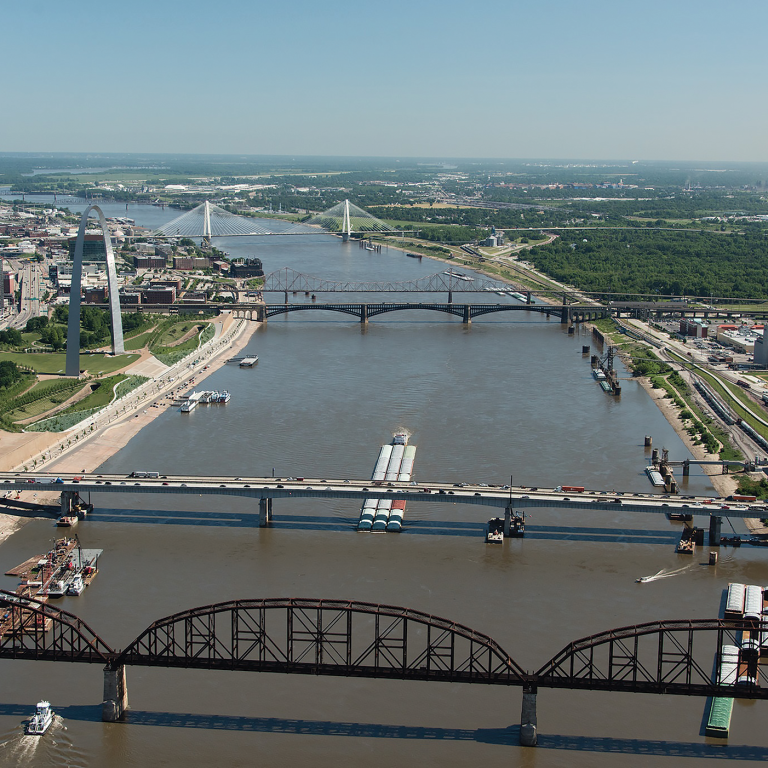

The St. Louis region is moving forward with a $9.2 billion freight infrastructure strategy through the St. Louis Regional Freightway’s 2027 Priority Projects List, which spans 29 projects across the bi-state area. So far, about $3.8 billion in funding has been secured, with roughly $1.6 billion already under construction. These investments aim to reinforce St. Louis’s standing as a major national freight and logistics hub.

The St. Louis Regional Freightway today released its 2027 Priority Projects List, which includes 29 projects representing a total investment topping $9.2 billion. The list highlights continued progress on critical infrastructure improvements across the bi-state St. Louis region.
The Freightway unveiled the list during the annual Freight Summit on Wednesday, June 10. The summit is the signature event of FreightWeekSTL, held this year aboard the Gateway Arch Riverboats. As of May 2026, the region had completed more than $581 million in projects on the list.
Funding Momentum Builds Across the Region
The region has secured nearly $3.8 billion in total funding so far. Construction is currently underway on projects totaling roughly $1.6 billion. With 41% of total project costs now funded, additional projects are expected to advance to construction soon.
“The list highlights the top infrastructure needs of the manufacturing and logistics industries in Eastern Missouri and Southwestern Illinois,” said Mary Lamie. She added that it serves as a valuable tool to advocate for support and funding for critical freight improvements that strengthen the region’s position as a world-class freight and logistics hub. Lamie is Executive Vice President of Multimodal Enterprises for Bi-State Development and head of the St. Louis Regional Freightway.
The Freightway’s Freight Development Committee compiles the Priority Projects List each year. This collaborative group brings together stakeholders from the Missouri and Illinois Departments of Transportation, the East-West Gateway Council of Governments, all modes of transportation, the manufacturing and logistics industries, and academia. Their process has earned national recognition for its effectiveness.
Leaders Spotlight Key Bi-State Projects
During the Freight Summit, Lamie was joined by Carrie Nelsen, Region Five Engineer for the Illinois Department of Transportation (IDOT), and Tom Evers, District Engineer for the Missouri Department of Transportation’s (MoDOT) St. Louis District. Together they discussed several of the most significant projects advancing across the region.
Nelsen highlighted construction of the $496 million Interstate 270 (I-270) Chain of Rocks Bridge. This joint IDOT and MoDOT project is currently underway to strengthen a critical bi-state freight corridor, along with associated work on I-270 in Madison County, Ill. She also discussed the $106 million Illinois Route 3 Connector, a fully funded project that includes 1.4 miles of new construction to improve traffic flow, accessibility, and network connectivity.
Nelsen also touched on the ongoing Illinois Rte. 158 (Air Mobility Drive) relocation from IL Rte. 161 to IL Rte. 15, a $70.3 million project. Construction is underway on the segment from IL Rte. 161 to IL Rte. 177. The project expanded this year to extend to IL Rte. 15, but that portion still awaits funding.
She emphasized the collaboration between the two transportation departments. “The bridges that span the Mississippi River are border bridges; they are shared 50%/50% between IDOT and MoDOT,” Nelsen said. “Usually there is one lead agency that you see as the face of a project, but both agencies are deeply involved in those projects since they are so expensive.”
Missouri Corridors Drive Major Investment
Evers echoed a similar theme. “We’re all here today because of freight and partnership and how important all that is working together to advance the transportation system in the region,” Evers said. “The Chain of Rocks Bridge is a great example of that.”
He discussed continuing work on I-270 on the Missouri side of the Mississippi River. This includes construction on the $34.5 million Riverview Drive Exchange and the gap project between the Riverview Interchange and MO Rte. 367.
Evers also highlighted major investments along the Interstate 70 (I-70) corridor. The $634 million improvement project from Warrenton to Wentzville is now under construction. It stands as the largest single project in MoDOT’s history and forms part of a broader $1.18 billion effort to improve I-70 from Warrenton to the Stan Musial Veterans Memorial Bridge.
He called the segment of I-70 from the Missouri River to approximately Interstate 170 (I-170) an unfunded need. This stretch would support planned improvements at St. Louis Lambert International Airport, and he encouraged the freight community to advocate for its funding.
Evers also touched on planned improvements to Interstate 44 (I-44) from the Oklahoma state line through Franklin County, Mo., a vital freight link across the state. The region has already secured more than $100 million to improve the I-44/U.S. 50 interchange and support other asset management along I-44, where total project costs are estimated at $200 million. Evers added that MoDOT is working with local partners and IDOT to advance a study on how best to address the depressed section of interstates in downtown St. Louis.
Lambert Terminal Leads the List
The largest single project on the 2027 list is the new terminal at St. Louis Lambert International Airport, now estimated to exceed $3 billion. The region has secured approximately $1 billion to advance several enabling projects.
Lamie highlighted several other fully funded projects on the list. These include $246 million in improvements to Interstate 55 (I-55) from Rte. Z to Rte. 67, which should finish later this year or early in 2027 and increase capacity along a heavily traveled freight route. She also pointed to the $75 million MacArthur Bridge Improvements over the Mississippi River and more than $67 million in improvements on I-64 from Green Mount Rd. to IL Rte. 158 (Air Mobility Dr.).
She said other projects could be well underway within the next few years. These include the $98 million multimodal Freight Yard expansion at the Madison Yard in Madison, Ill., and various projects at the bi-state area’s ports. Those port projects support the region’s position as the Ag Coast of America and the nation’s most efficient inland port system.
Advocacy Continues for Unfunded Needs
Lamie said the Freightway will keep advocating for funding for the projects that remain unfunded. These include the $629 million replacement of the Martin Luther King Bridge over the Mississippi River, the $570 million project to add lanes on I-55/70 from Interstate 255 (I-255) to I-270, Illinois Route 3 access improvements, and distribution improvement projects at MidAmerica St. Louis Airport.
“It’s clear the collaboration that is the foundation of the annual Priority Projects List contributes to the forward movement of the projects on our list,” Lamie said. She added that the region will continue to advance projects through a sustained period of significant infrastructure investment. These investments, she noted, will benefit the supply chain for the region and the nation and will support the bi-state area’s abundance of developer-ready industrial real estate sites.
How to Learn More and Get Involved
More details about each project, its funding status, timeline, and expected benefits are available at FreightWeekSTL.com. The Freightway will submit the 2027 Priority Projects List to the East-West Gateway Council of Governments for approval later this year. The public can submit comments on the Priority Projects online at TheFreightway.com/contact/ or contact Mary Lamie at 314-982-1562.
FreightWeekSTL 2026 continues through June 12. To learn more, register for the remaining virtual panel sessions, or view sessions once they have been released, visit www.FreightWeekSTL.com.
About St. Louis Regional Freightway
The St. Louis Regional Freightway (the Freightway) serves as the region’s authority for coordinating support for industrial businesses and the logistics infrastructure they depend on. It provides site selection and business assistance to manufacturing, logistics, and multimodal transportation companies and their service providers. As an enterprise of Bi-State Development, the Freightway partners with public sector and private industry businesses to advocate for infrastructure development that supports the movement of freight. It also leads initiatives to grow the region’s talent pool and plays a critical role in marketing the region as a world-class manufacturing and distribution cluster within the City of St. Louis and seven adjacent counties in Missouri and Illinois. To learn more, visit TheFreightway.com.
#StLouis #Freightway #Infrastructure #Transportation #RegionalDevelopment #PriorityProjects #Investment #Logistics #BiStateRegion #EconomicGrowth