

DISC Health Equity Action Lab
Digital pathology transforms traditional microscope-based review into a data-driven workflow using high-resolution Whole Slide Images (WSI) and Image Management Systems (IMS). DigPath Inc, founded by Webster Lincoln and Dr. Inema Orukari, delivers rapid, serverless digital pathology to accelerate diagnostics, reduce reporting times, and enable global collaboration.

Understanding the Foundation: What is Digital Pathology?
Digital pathology is changing how we look at tissue samples. Instead of using old glass microscopes, labs now use a data-driven system. This new process relies on high-resolution Whole Slide Images (WSI) and Image Management Systems (IMS). DigPath Inc, started by Webster Lincoln and Dr. Inema Orukari, offers fast, serverless tools to make this happen. As a result, they help medical teams speed up testing, cut wait times, and connect experts around the world.
Understanding the Basics: What is Pathology?
First, we need to know what pathology actually means. Simply put, it is the scientific study of disease. For the most part, doctors divide this field into two main groups: anatomic and clinical pathology. You can learn more about these roles from the Cleveland Clinic. Knowing these groups makes it easier to see how digital tools improve the daily workflow.
- Anatomic Pathology: This involves looking at physical parts like organs and tissues. Common examples include biopsies and Pap smears.
- Clinical Pathology: This focuses on testing body fluids like blood and urine. It covers areas like finding infections or checking for blood disorders.
How the Digital Pathology Process Works
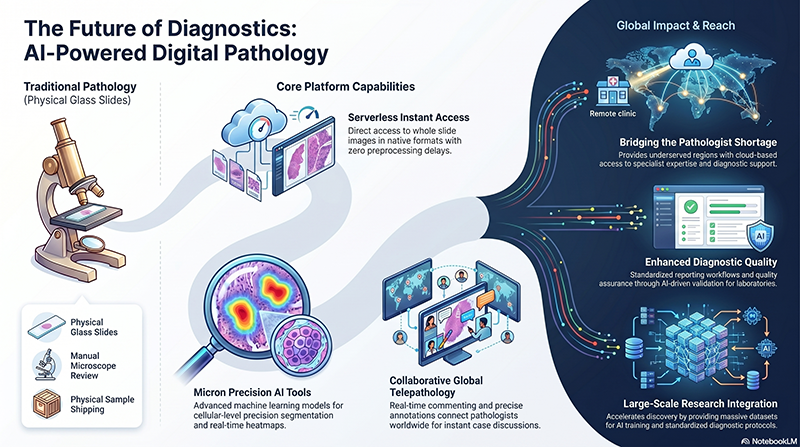
Digital pathology is a special tech field that manages health data on computers. Rather than looking through a classic lens, experts turn glass slides into large digital files.
Furthermore, moving from a physical setup to a smart system takes a few clear steps:
- Tissue Prep: Lab workers place tissue on glass slides using normal methods.
- Fast Scanning: Next, a rapid scanner takes pictures of the whole slide. This creates huge files that are often larger than 1 GB.
- Uploading Data: Then, the staff uploads these images to an Image Management System (IMS).
- Screen Review: Afterward, doctors can zoom in and move around the image on a medical screen. This feels just like using a real microscope.
- Adding AI: Finally, Artificial Intelligence (AI) software steps in. It counts cells and finds patterns faster and more fairly than human eyes alone.
Top Benefits of Digital Pathology Software
Bringing this tech into your lab with DigPath offers many great perks. For example, it allows for remote talks, better speed, sharper accuracy, and improved comfort. Ultimately, these benefits give health clinics faster and more trusted results.
Remote Talks and Global Teamwork
Telepathology lets doctors talk from far away. Because of this, global experts can look at hard cases right away without mailing physical slides across the country. See this NCBI study for more details on how it works.
Better Daily Speed
Digital setups cut out slow manual tasks. Therefore, workers no longer waste hours digging through dusty files or waiting for delivery drivers to drop off samples.
Sharper Accuracy with AI
Smart AI tools act as a helpful second pair of eyes. In fact, they spot tiny details and repeat math tasks perfectly every time.
Improved Worker Comfort
Doctors can now work in a much better setting. Sitting at a high-quality screen helps stop the neck and back pain caused by bending over a microscope all day.
Empowering Labs with DigPath Inc
DigPath Inc opened its doors in 2023 to help medical labs get faster results and save money. Their special serverless platform stops annoying delays and makes daily tasks run smoothly. In addition, their AI tools work well with major medical brands to keep testing sharp and flexible.
To see how this platform can help your team right now, lab leaders should set up a custom meeting. Reach out to the team at info@digpath.com to book your spot. Take the next step today and move your lab into the future of medicine.
| Category | Definition | Key Focus Areas |
|---|---|---|
| Anatomic Pathology | The study of disease by examining physical structures like organs and tissues. | Biopsies, cytopathology (e.g., Pap smears), and autopsies. |
| Clinical Pathology | The study of disease through laboratory analysis of bodily fluids. | Microbiology, hematology, and clinical chemistry. |
[2] https://www.merriam-webster.com
[3] https://pmc.ncbi.nlm.nih.gov
[5] https://my.clevelandclinic.org[6] https://websterlincoln.com
About
Lawrence Jones II, PhD.
Dr. Lawrence Jones II, Ph.D., is the founder and CEO of Biotechnology Health Management and Care LLC in Pikesville, MD. With a doctorate in Entrepreneurial Leadership from Regent University, his research focuses on entrepreneurial leadership in biotechnology. Dr. Jones has extensive academic and professional credentials, including degrees from Webster University, Johns Hopkins University, and UMBC, alongside certifications in entrepreneurship and business development.
Learn more about Lawrence Jones II, PhD.
Visit: biotechhmc.com
DISC Health
The Health Equity Action Lab (HEAL) is an initiative by Dynasty Interactive Screen Community aimed at addressing health disparities in the U.S. and globally. By engaging media and stakeholders, HEAL seeks to reduce health inequalities and raise awareness. Their approach includes overcoming socio historical barriers and confronting the institutional, social, and political factors that perpetuate healthcare inequality.
Learn more about the health education partnership:
Howard University Hospital (HUH)
Howard University Hospital, established in 1862 as Freedmen’s Hospital, has a rich history of serving African Americans and training top medical professionals. Located in Washington, D.C., it is the only teaching hospital on the campus of a historically Black university. HUH is a Level 1 Trauma Center and a critical healthcare provider for underserved populations. It offers advanced medical services, including robotic surgery, and has received numerous accolades for excellence in specialties like heart care, stroke treatment, and radiology.
Learn more about Howard University Hospital (HUH)
Howard University Faculty Practice Plan (FPP)
The Howard University Faculty Practice Plan is a multi-specialty physician group in Washington, D.C., dedicated to advancing healthcare and eliminating health disparities. It offers comprehensive services, including primary and specialty care, mental health, imaging, and cancer care, all connected to Howard University Hospital. FPP emphasizes patient-centered, respectful care for the diverse community and provides free health screenings and events to promote wellness.
Learn more about Howard University Faculty Practice Plan (FPP).
#DigitalPathology #HealthcareInnovation #AIinMedicine