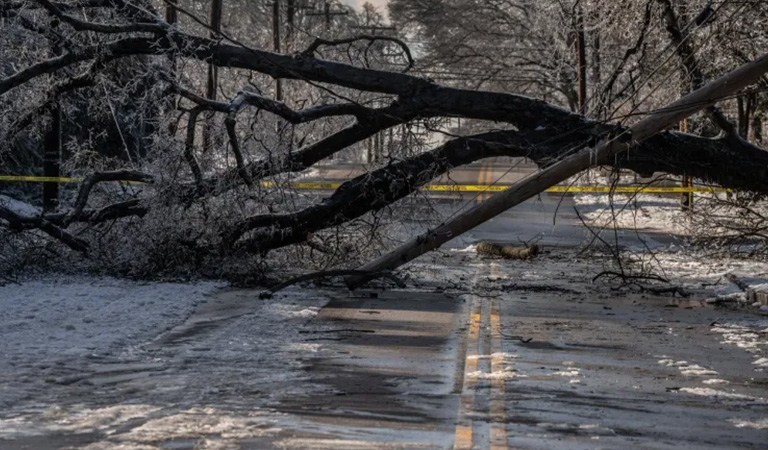


When a tornado tears through a neighborhood, it doesn’t just rip roofs off homes or snap trees in half—it unravels lives. In those first few hours and days, people are trying to find their footing: checking on loved ones, salvaging keepsakes, wondering what comes next. The urgency of those moments is real. But what often gets overlooked is what happens weeks, months, and even years later.
As someone who has worked at the local, state, and federal levels responding to disasters, I’ve seen this pattern far too often: initial support floods in, media attention peaks, and then—slowly—the help fades, but the need remains. Long after the debris is cleared, families are still struggling to rebuild homes, access food and health care, find stable housing, and deal with the trauma of what they’ve survived.
This is why Saint Louis must urgently move from a reactive response model to one rooted in resilience. Recent disasters have exposed the vulnerabilities of our systems and the inequities that persist across neighborhoods. While the City has a CDBG Disaster Recovery Action Plan, it is not widely known or embraced across sectors, leaving many residents and organizations unaware of how to engage or benefit. A truly effective recovery requires transparency, coordination, and the participation of every stakeholder—from elected officials to grassroots leaders to everyday residents.
This article provides practical guidance to ensure Saint Louis doesn’t repeat the mistakes of the past. Below is a community-driven framework that supports long-term recovery and sets a precedent for how we prepare for future disasters.
1. Accurate Damage Documentation: The Foundation for Recovery
Accurate documentation is essential to secure federal reimbursement and accelerate rebuilding. Key steps include:
Photographing all structural and utility damage.
Saving receipts for emergency repairs and displacement costs.
Promptly reporting to insurance and FEMA (DisasterAssistance.gov or 800-621-3362).
Houston’s organized digital documentation post-Hurricane Harvey allowed for faster FEMA approval and resource allocation (City of Houston, 2018).
2. Resource Mapping and Service Coordination
Knowing what assets exist before a disaster strikes enhances effectiveness:
Develop a living map of shelters, clinics, food banks, transportation, and more.
Use GIS systems and FEMA’s Community Recovery Management Toolkit to support mapping.
Update contact info and availability quarterly.
New Orleans’ “NOLA Ready” portal helped streamline service access and minimize duplication (City of New Orleans, 2022).
3. Mobilizing Resources Strategically
Swift action saves lives. Pre-established systems are key:
Form Local Recovery Committees led by emergency management professionals.
Create mutual aid agreements in advance.
Use vetted volunteer databases and provide training.
In Joplin, MO, rapid response was possible due to pre-existing MOUs and coordination between nonprofits and city officials (NIST, 2022).
4. Inclusive and Culturally Competent Community Engagement
True recovery includes everyone:
Host multilingual, accessible public forums with child care and transportation options.
Engage churches, barbershops, and schools to spread trusted messaging.
Compensate local liaisons for year-round outreach.
Minneapolis improved engagement by embedding neighborhood resilience ambassadors (City of Minneapolis, 2021).
Special consideration must be given to children, seniors, individuals with disabilities, the unhoused, immigrants, and low-income families to ensure resource equity.
5. Leadership Accountability: Governance That Works
Elected and appointed officials have a moral and operational obligation:
Align city and state budgets with real recovery needs based on public health and housing data.
Create equity impact assessments for new and existing legislation.
Reevaluate laws that restrict access to aid based on documentation, disability, or immigration status.
Post-Hurricane Sandy, New York passed reforms to simplify insurance claims and provide housing aid, showing how responsive legislation can stabilize communities (NY State, 2014).
6. The Cost of Inaction: Broken Systems and Lost Trust
Failure to plan equals failure to recover:
Without coordination, displaced families face prolonged trauma.
Aid may be distributed inequitably, worsening pre-existing disparities.
Lost opportunities to build climate-resilient infrastructure are rarely regained.
Puerto Rico’s recovery from Hurricane Maria has been slow in part due to a lack of cohesive long-term planning, especially in remote areas with aging infrastructure.
7. Building Toward a More Resilient Future
Recovery isn’t about returning to what was—it’s about creating what’s needed:
Invest in mental health services and trauma-informed care.
Retrofit infrastructure to withstand future storms.
Host community preparedness fairs and train residents in emergency roles.
Mayfield, KY used zoning reforms and shelter investments post-2022 tornado to increase future preparedness.
The Will to Move Forward.
We cannot afford to approach recovery as a short-term fix. We must treat it as a collective responsibility to restore dignity, health, safety, and hope. Saint Louis has the opportunity to become a national model for inclusive, long-term recovery—if we choose to act boldly and together.
This moment must be more than a traumatic memory. Let it be the beginning of something better.
References
City of Houston. (2018). Hurricane Harvey After Action Report. Retrieved from https://www.houstontx.gov
City of Minneapolis. (2021). Resilience in Our Neighborhoods Initiative. Retrieved from https://www.minneapolismn.gov
City of New Orleans. (2022). NOLA Ready Emergency Preparedness. Retrieved from https://ready.nola.gov
Federal Emergency Management Agency (FEMA). (2023). Community Recovery Management Toolkit. https://www.fema.gov/emergency-managers/practitioners/recovery-resources/community-toolkit
Federal Emergency Management Agency. (2023). Community Engagement Toolkit. https://www.fema.gov/emergency-managers/practitioners/recovery-resilience-resource-library/community-engagement-toolkit
Federal Emergency Management Agency. (2023). Public Assistance Program and Policy Guide (PAPPG). https://www.fema.gov/sites/default/files/documents/fema_pa_pappg-v5.0_012025.pdf
National Institute of Standards and Technology (NIST). (2022). Community Resilience Planning Guide for Buildings and Infrastructure Systems.
New York State. (2014). NY Rising Community Reconstruction Program. Retrieved from https://stormrecovery.ny.gov
Dr. Frederick Echols, MD, is available as a subject matter expert on public health for press interviews and speaking engagements.
###
About Dr. Fredrick Echols, MD
Dr. Fredrick L. Echols, MD is the founder and Chief Executive Officer of Population Health and Social Justice Consulting, LLC, an Obama Foundation Global Leader, sought-after public speaker, black men’s health advocate, and accomplished physician with over 15 years of experience in public health. He has worked extensively with public and private sectors to address complex health issues through evidence-informed approaches. Dr. Echols is a graduate of the Centers for Disease Control and Prevention Population Health Training in Place program and the ASTHO-Morehouse School of Medicine’s Diverse Executives Leading in Public Health program.
Passionate about health and justice, Dr . Echols’ notable roles include serving as Chief Executive Officer for Cure Violence Global, Health Commissioner for the City of St. Louis, and Director of Communicable Disease and Emergency Preparedness for the St. Louis County Department of Public Health. In these roles, he oversaw public health regulations, led COVID-19 response efforts, managed daily operations, and developed strategic partnerships. Dr. Echols also served as Chief of Communicable Diseases for the Illinois Department of Public Health and as a physician in the U.S. Navy. He continues to contribute to public health research and guides health organizations globally.
For more health tips follow Dr. Fredrick Echols @ Fredrick.Echols@gmail.com
Follow Dr. Echols on socials:
LinkedIn: @FredrickEcholsMD ( www.linkedin.com/in/fredrick-echols-m-d-5a2063225)
Facebook: @FredrickEchols
Instagram: @F.EcholsMD
#DisasterRecovery #SaintLouis #CommunityResilience