


Articulated Insight – “News, Race and Culture in the Information Age”

Let me say this plainly: inclusive leadership is no longer an optional skill. In a noisy, polarized environment, how work gets done, how people decide whether to stay, and how organizations protect their brand all depend on the standard you set.
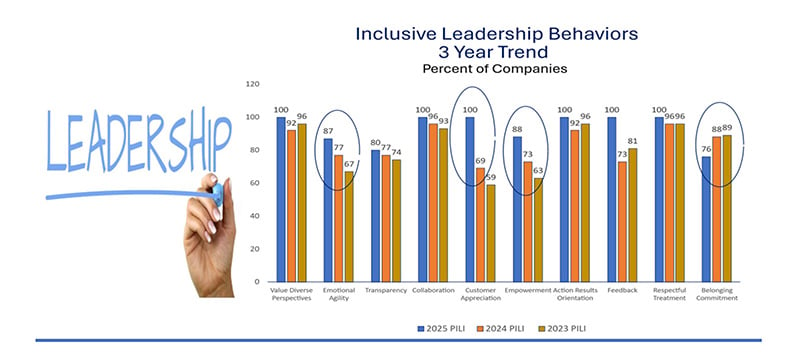
Recent data reveals an encouraging trend. Up to 100% of companies report that their leaders value diverse perspectives, treat people with respect, and commit to fostering belonging. However, a tension exists. Employees no longer grade companies based on the mere presence of a corporate value statement. Instead, they watch how we behave on a random Tuesday afternoon during a high-pressure staff meeting. That is exactly where inclusive leadership either shows up or falls flat.
This guide bridges the gap between good intentions and everyday practices. We will explore what recent workplace data tells us and provide actionable anchors you can use right now to build a profound sense of belonging on your teams.
The Reality of Inclusive Leadership in the Workplace
Over the past three years, clear patterns have emerged regarding how organizations approach diversity and team culture:
- Table stakes are set: Valuing diverse perspectives, collaboration, and respectful treatment sit at or near 100% for most companies. Leaders know these elements are essential.
- Belonging is climbing: Commitments to belonging, feedback, and empowerment have steadily increased. Organizations now expect leaders to create space, not just deliver raw results.
- The hard work remains: Emotional agility and transparency are improving, but they started from a lower baseline. Managing personal reactions, having honest conversations, and staying open during uncomfortable moments require ongoing effort.
- Stress reveals habits: Customer appreciation and action orientation remain strong, but they fluctuate. When the business experiences stress, leaders often default to old habits and neglect inclusion.
The core story is not that leaders lack care. The truth is that most leaders care deeply but apply their skills inconsistently. You need simple, repeatable practices that fit into real life, rather than a dense playbook that gathers dust on a shelf.
For more insights on shaping positive workplace narratives, explore the resources available at The Narrative Matters.
Review recent studies on diversity and business performance.

Unlock the power of storytelling to influence and inspire! Join D’Ericka Stevenson, Founder & CEO of Mushy Guru, for Storytelling™: Influence and Inspire, a transformative webinar focused on strategic communication. Learn to craft compelling visual stories, use message and logic to drive action, and master techniques to interpret your unique narrative. Don’t miss this opportunity to elevate your communication skills and make a lasting impact. Register now!
5 Anchors of Effective Inclusive Leadership
Think of these five strategies as your anchors. You do not need to execute all of them perfectly every single day. However, if you drift too far from any of them, a sense of belonging will begin to erode.
1. Show Up Where People Gather
Senior leaders frequently voice support for Business Resource Groups (BRGs), Employee Resource Groups (ERGs), and broader inclusion efforts. But the real question is: Do your people actually see you there?
- Sponsor and attend: Sponsor an ERG and actively show up to listening sessions, panels, and informal conversations.
- Engage deeply: When you enter the room, skip the standard opening remarks. Ask meaningful questions, listen closely, and connect what you hear to broader business priorities.
Employees interpret your physical presence as a true commitment. Conversely, absence or silence sends a remarkably clear, negative message.
2. Manage By A Real Scorecard, Not A Feeling
Most leaders genuinely believe they act fairly, but the data often disagrees. Implementing an inclusive leadership scorecard keeps everyone honest. At least once a quarter, review the following metrics:
- Representation across every individual team.
- Promotion rates and patterns of stagnation.
- Pay equity aligned with specific role levels.
- Engagement and retention trends among different demographic groups.
The goal is not to shame anyone. The goal is to surface hidden patterns and set personal goals. For example, you might say, “This year, I will ensure my project leads reflect the talent on my team.” What gets measured, moves.
3. Build Listening And Feedback Into The Rhythm Of Work
Employees feel exhausted by “we are listening” campaigns that never result in action. Effective leaders treat listening as a continuous loop, not a singular event. Try adopting this rhythm:
- Host open sessions: Schedule monthly or quarterly informal sessions where employees can ask tough questions.
- Run digital pulse checks: Ask three to five targeted questions. How safe do you feel speaking up? Do you understand our decision-making process? What is one thing we could do better?
- Provide summaries: Issue a simple “You said / We are doing” update after each round of feedback. Even if the answer is “we are not changing this right now, and here is why,” people appreciate knowing you heard them.
Feedback must also flow the other way. Employees frequently report guessing where they stand. Delivering short, frequent, and specific feedback serves as one of the strongest tools you possess to foster belonging.
4. Make Inclusion Part Of The Meeting
Workplace culture primarily happens in meetings. It lives in who talks, who gets interrupted, and whose ideas gain traction. You do not need a massive toolkit to fix this; you just need consistent habits:
- Rotate voices: Change who speaks first, especially when making major decisions.
- Pause intentionally: Ask, “Who hasn’t weighed in yet?” and genuinely wait for a response.
- Seek understanding: When you disagree, say, “Help me understand how you are seeing it,” before launching into your own perspective.
- Review real scenarios: Once a month, introduce a brief inclusion case study to your team meetings. Discuss realistic challenges, like navigating a biased client comment or managing a hybrid schedule that disadvantages certain roles.
These small actions build psychological safety over time. When psychological safety increases, high performance naturally follows.
5. Protect Both Physical And Psychological Safety
We frequently treat safety as a facilities issue or a basic compliance checkbox. In reality, it represents a core leadership behavior. Outstanding leaders take deliberate steps to protect their teams:
- Expect concerns: Make it explicitly clear that you value and expect employees to raise concerns.
- Clarify channels: Explain exactly what reporting channels exist (such as HR or an anonymous line) and outline what happens after someone uses them.
- Follow through: Address issues visibly without compromising confidentiality. A simple statement like, “We heard concerns about the new schedule; here is how we are addressing it,” builds immense trust.
When people feel physically and psychologically secure, belonging grows. Simultaneously, turnover, risk, and toxic whisper networks shrink.
Your Quick Inclusive Leadership Checklist
If you want a practical tool to keep on your desk, use this quick checklist to evaluate your progress:
- Did I show up this month where my people gather?
- Did I review my team data (hiring, promotion, pay, engagement) through an inclusion lens and act on at least one insight?
- Did I close the loop on a concern employees raised?
- Did I intentionally create space in my meetings for different voices and perspectives?
- Did I reinforce safety based on how I responded to a hard question, a mistake, or a complaint?
You do not have to be flawless. But if you move the needle on these five questions month after month, your team will feel the difference long before the next annual survey tells you so. That is inclusive leadership in practice. It is exactly how we build workplaces where people choose to stay, grow, and lead alongside us.

Pam McElvane, CEO, Author & Publisher, Promena Media
CEO | Master Coach | Board Governance Expert | Data Scientist | Strategist | Publisher
Pamela McElvane, MBA, MA, MCPC, is the CEO and founder of P&L Group, Ltd which has 3 key brands: Promena, 3I Research Institute & Diversity Learning Solutions, headquartered in Chicago, IL. Ms. McElvane has spent more than 25 years working with large and midsize companies providing insights and best practices, leadership and executive coaching, strategy, and organizational management.
About Promena (A P&L Group Brand)
Promena.Set the Standard (previously Diversity MBA) is a media, leadership, learning, research, and insights company dedicated to setting the standard for inclusion, equity, and performance. Through data-driven benchmarks, executive education, and thought leadership, Promena helps organizations turn inclusion from aspiration into a measurable business capability.
About Promena Insights
Promena Insights is the research and analytics division of Promena. It develops proprietary indices, benchmarks, and frameworks—including the Inclusive Leadership Index™ (ILI) and the Industry Inclusion Index (I³)—to measure inclusion maturity and guide evidence-based strategy for organizations and industries.
Contact for public speaking, coaching and leadership training opportunities:
833-362-2100 ext. 700 (Main)
#InclusiveLeadership #FutureReadyTeams #WorkplaceDiversity