
DiSC Plus: The Beat That Never Quits: Inside the Legendary World of D.C.’s Go-Go Music,” celebrates the rich history and enduring legacy of Washington, D.C.’s official music genre. Originating in the mid-1970s through the creative genius of “Godfather of Go-Go” Chuck Brown, the genre blends funk, rhythm and blues, and early hip-hop with a relentless, non-stop percussion beat. This unique groove relies heavily on congas, cowbells, and seamless, live call-and-response interaction between the band and the crowd. More than just a musical style, the article illustrates how go-go serves as the rhythmic heartbeat and cultural soul of Washington’s Black community, surviving decades of gentrification, nightclub closures, and institutional pushback to remain an unmuted symbol of local identity.

If you have ever spent more than five minutes walking the streets of Washington, D.C., you have probably felt it. It’s a rhythmic, low-end rumble that vibrates right up through the soles of your shoes. It is the sound of congas, cowbells, and rototoms locked in a hypnotic, syncopated groove.
This isn’t just background noise. This is Go-Go music—the official state music of Washington, D.C., and the absolute cultural heartbeat of the District’s Black community.
At DiSC Plus, we love music with a soul, a history, and an undeniable ability to make you move. So grab your earplugs and your dancing shoes: we’re diving deep into the history, the heavy hitters, and the modern evolution of the genre that quite literally refuses to stop.
What is Go-Go? (Hint: The Percussion Never Stops)
To understand Go-Go, you have to understand the “Pocket.”
Unlike traditional funk or R&B, which has clear-cut beginnings and endings to songs, Go-Go is designed to keep the party moving continuously. Born in the mid-1970s, the genre got its name because the percussionists simply keep going between songs. Instead of silence, the band drops into a continuous, rolling beat while the bandleader talks to the crowd.
This structure creates an electric, highly interactive live experience anchored by two key ingredients:
- The Call-and-Response: Bandleaders interact continuously with the crowd, shouting out neighborhoods, crew names, and dance moves, making the audience an active instrument in the band.
- The Syncopated Polyrhythm: The groove is driven not by a standard drum kit, but by a dense wall of percussion—congas, rototoms, and the iconic, driving clank of the cowbell.
The Pioneers: Who Built the Groove? (1970s–1980s)
Every musical movement has its royalty, and Go-Go’s family tree is rooted in pure genius. During its golden age in the 1980s, the genre survived and thrived on a massive, highly localized underground cassette economy. Long before internet streaming, D.C. youth were buying bootleg “papes” (cassette tapes) of live show recordings at corner stores to hear the latest sets.
These are the legendary acts that built the foundation:
- Chuck Brown & The Soul Searchers: The undisputed “Godfather of Go-Go.” Chuck Brown conceived the genre in the 1970s at local spots like the Maverick Room. His 1978 anthem “Bustin’ Loose” became the definitive blueprint for the genre.
- Trouble Funk: These pioneers injected heavy synthesizers and spacey, electro-funk vibes into the sound, releasing the massive regional hit “Pump Me Up.”
- E.U. (Experience Unlimited): E.U. brought a raw, rock-guitar energy to the pocket. They took Go-Go to the national stage with their massive 1988 hit “Da Butt,” featured in Spike Lee’s classic film School Daze.
- Rare Essence: Formed when the members were still in elementary school, “R.E.” became one of the most enduring, hard-hitting bands in history, known for their hypnotic, driving tempos.
- Junkyard Band: Proving that Go-Go is about spirit rather than fancy gear, Junkyard Band was started by kids in the projects playing plastic buckets, tin cans, and hubcaps before evolving into a major-label force.
The Modern Era: From “New School” to “Bounce Beat” (1990s–Present)
As hip-hop began dominating the airwaves in the 1990s and 2000s, Go-Go did what it does best: it adapted and kept on rolling. The genre split into fascinating new subgenres that continue to soundtrack the city today.
| Era / Style | Key Characteristics | Pioneer Artists |
| The “New School” | Raw, aggressive, heavily influenced by 90s street hip-hop and rap. | Backyard Band (fronted by Anwan “Big G” Glover) |
| The “Bounce Beat” | Fast-paced, high-energy, with heavy emphasis on the double-kick drum and dramatic, crashing rhythms. | TOB (Take Over Band) |
| “Grown & Sexy” | Smooth, soulful, transforming contemporary R&B hits over a classic pocket beat. | Vybe Band |
| All-Female Power | Challenging the male-dominated history of the genre with powerhouse, high-energy live touring sets. | Be’la Dona |
| Electronic Fusion | Integrating modern electronic elements and synthesizers with the traditional live instrumentation. | Sirius Company (founded in 2018) |
Why Go-Go Matters Today: Culture, Protest, and Preservation
Go-Go is far more than just a party soundtrack; it is an act of resilience.
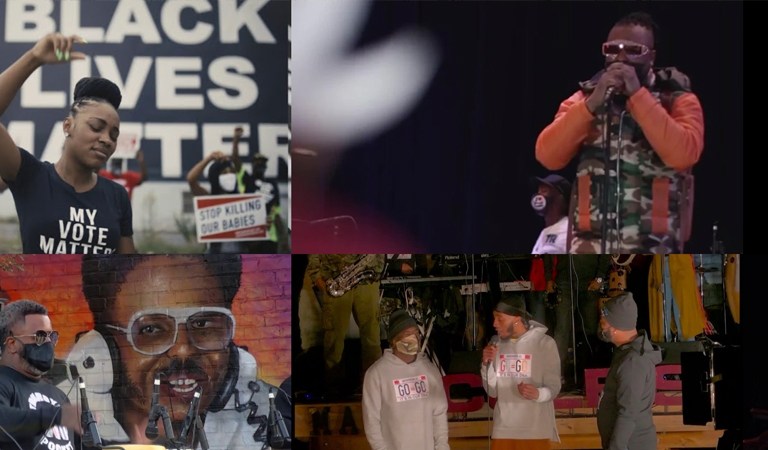
As Washington, D.C. has faced rapid gentrification over the last two decades, Go-Go has become a rallying cry for the preservation of Black culture in the District. In 2019, when a local mobile store in the historic Shaw neighborhood was forced to silence the Go-Go music it had played on its sidewalk corner for decades, the city erupted in the #DontMuteDC movement.
The protests weren’t just peaceful—they were loud, joyful street parties where Go-Go bands played on flatbed trucks.
A Major Victory: In 2020, the District officially designated Go-Go as the state music of Washington, D.C., passing legislation to protect and fund its heritage. Today, you can visit the Go-Go Museum & Cafe in historic Anacostia to see the archives, touch the instruments, and celebrate the heartbeat of D.C.
Go-Go music proves that as long as you keep the pocket alive, the community will always find its rhythm.
#GoGoMusic, #DontMuteDC, #DCHistory