
The rapid acceleration of corporate AI transformation is actively shifting the financial and structural burdens of technological adaptation onto small businesses and individual workers. While massive tech entities leverage AI to justify immediate workforce reductions and capital reorganization, small businesses—which historically drive over 52% of net job growth—are being positioned as a consumer base forced to self-finance their own operational readiness. True organizational leadership requires navigating this shift without compromising human workforce stewardship.

Articulated Insight – “News, Race and Culture in the Information Age”

Let’s stop pretending we do not see what is happening.
The conversation around AI has been dressed up in the language of innovation, productivity, and future readiness. And yes, AI is here. It is real. It is powerful.
But let’s also be honest: in too many boardrooms, “AI transformation” is becoming a cleaner, shinier way to talk about workforce reduction, budget tightening, and shifting the cost of adaptation onto everybody else.
This week’s announcements made that plain:
- Meta announced it is cutting about 8,000 workers—roughly 10% of its workforce—while continuing to ramp up spending tied to AI infrastructure and AI talent.
- Microsoft is offering voluntary buyouts to thousands of longtime U.S. employees at the same time it continues massive AI infrastructure investment.
So no, people are not imagining this.
The True Backbone of the Economy
Let’s be careful with the numbers because they matter. The latest economic data shows a stark reality:
- Job Growth: Small employers accounted for more than 52% of job gains between 2021 and 2024.
- Employment Volume: Small businesses employ 62.3 million people, or 45.9% of private-sector workers.
Small business is not a side conversation in the American economy. It is the backbone. It is where resilience lives. It is where a huge share of the workforce will either be prepared for this next chapter or left to figure it out alone.
That is why I am watching this moment with clear eyes.
📢 Community Impact Spotlight: Shape the Future of Chicago Resources
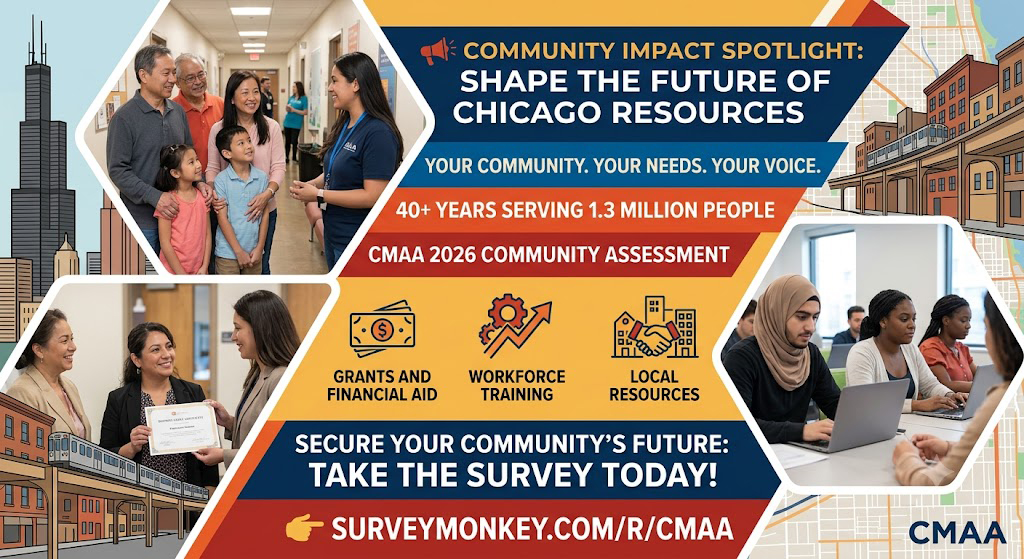
Are you tired of business programs and neighborhood initiatives that don’t quite fit your day-to-day realities? For over 40 years, the Chinese Mutual Aid Association (CMAA) has been a cornerstone for Chicago-area families and entrepreneurs, serving over 1.3 million people across Uptown, West Ridge, and Elgin. Now, heading into the second half of 2026, CMAA is launching a brief community assessment to find out exactly what kind of financial assistance, workforce training, and local grants your neighborhood needs most right now.
Don’t leave community resources on the table. By taking just five minutes to complete this survey, your feedback will directly guide future funding and ensure local support goes precisely where it will help your bottom line. Secure your community’s future and make your voice count today at surveymonkey.com/r/CMAA.
Shifting the Cost of Adaptation
Large companies are reducing headcount, reducing costs, and reorganizing for AI efficiency. But many of those same companies are also building products, subscriptions, training offers, and “skilling” pathways that smaller businesses are now expected to buy if they want to keep up.
Microsoft, for example, is explicitly marketing Microsoft 365 Copilot Business to small and medium-sized businesses and promoting skilling kits to help them get value from that investment.
That tells you something important about the new playbook: some of the largest firms are not simply transforming themselves for AI. They are also positioning smaller businesses as customers who must finance their own catch-up.
That is the part people need to stop romanticizing.
Innovation vs. Stewardship
This is not an anti-AI message. Let me be very clear.
- I believe in innovation.
- I believe in using technology wisely.
- I believe organizations should modernize, and I believe leaders have to prepare people for what is next.
But I do not believe in confusing efficiency with stewardship. I do not believe in celebrating the future while quietly disinvesting in the people who helped build the present.
And I say that as someone who has had to face this reality myself.
The New Playbook for Leaders
We are launching a new brand, yes. But more than that, we are launching a new playbook. A better one. One grounded in truth, not trendiness. One that understands that if the rules of work are changing, then leadership has to change too.
We cannot wait for large institutions to rescue workers, reskill communities, or protect small businesses from disruption. We have to build models that are honest about what is being lost, clear about what is being demanded, and bold enough to prepare people anyway.
The Transfer of Responsibility
This moment is not just about technology. It is about a transfer of responsibility. The question is no longer whether AI is changing work. It is.
The real questions are: Who pays for the transition? Who benefits from the gains? And who gets left holding the bill?
Right now, too many workers are paying with uncertainty, and too many small businesses are being told to pay with already-stretched dollars. Meanwhile, global employers themselves say AI will reshape jobs deeply.
According to data from the World Economic Forum:
- 59 out of every 100 workers worldwide are projected to need reskilling or upskilling by 2030.
- 41% of employers expect to reduce their workforce where AI can automate tasks.
The New Standard
So here is my message: do not be confused. Be real.
Read the signals. Believe what the market is showing you. Prepare your people. Protect your values. And build the kind of organization that does not just chase efficiency but also honors human contribution.
That is the new standard. And that is the playbook we are choosing to write.
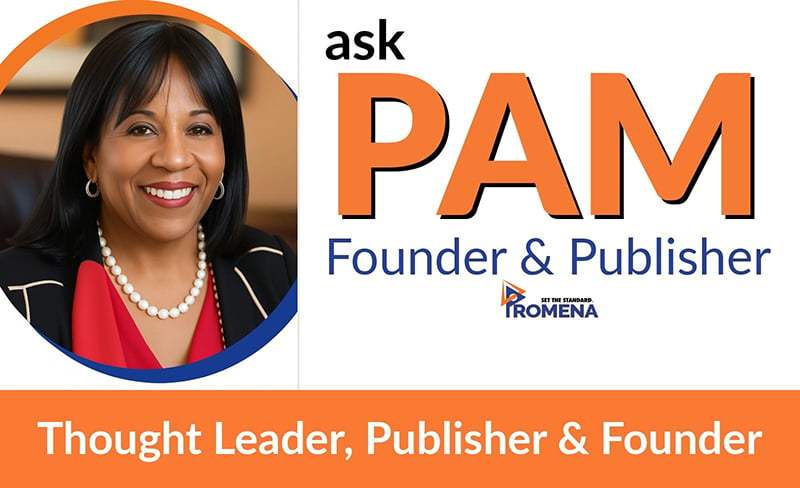
Pam McElvane, CEO, Author & Publisher, Promena Media
CEO | Master Coach | Board Governance Expert | Data Scientist | Strategist | Publisher
Pamela McElvane, MBA, MA, MCPC, is the CEO and founder of P&L Group, Ltd which has 3 key brands: Promena, 3I Research Institute & Diversity Learning Solutions, headquartered in Chicago, IL. Ms. McElvane has spent more than 25 years working with large and midsize companies providing insights and best practices, leadership and executive coaching, strategy, and organizational management.
About Promena (A P&L Group Brand)
Promena.Set the Standard (previously Diversity MBA) is a media, leadership, learning, research, and insights company dedicated to setting the standard for inclusion, equity, and performance. Through data-driven benchmarks, executive education, and thought leadership, Promena helps organizations turn inclusion from aspiration into a measurable business capability.
About Promena Insights
Promena Insights is the research and analytics division of Promena. It develops proprietary indices, benchmarks, and frameworks—including the Inclusive Leadership Index™ (ILI) and the Industry Inclusion Index (I³)—to measure inclusion maturity and guide evidence-based strategy for organizations and industries.
Contact for public speaking, coaching and leadership training opportunities:
833-362-2100 ext. 700 (Main)
#AIWorkforceTransformation #FutureOfWork #LeadershipEthics