

Articulated Insight – “News, Race and Culture in the Information Age”
In Chicago, a quiet yet powerful demonstration of solidarity is taking shape. In September 2025, the U.S. Department of Homeland Security (DHS) announced a major enforcement surge in the Chicago area, dubbed Operation Midway Blitz. As reported by the Chicago Sun Times, the operation is said to target noncitizens in the U.S. without authorization who have “criminal records.”
According to reporting, in the first week the arrests numbered in the hundreds, raising alarm among immigrant-rights groups and local officials. ICE’s Chicago Field Office states its Enforcement and Removal Operations aim at individuals who present “the greatest risk to national security, public safety or border security.” A New Yorker article titled, “The Conflict on the Streets of Chicago” claims that there are reports of civil immigration arrests outside courthouses, in sidewalks, in neighborhoods, and even involving U.S. citizens who claim they were detained by mistake. The last claim in particular draws ICE’s proclaimed mission into question.
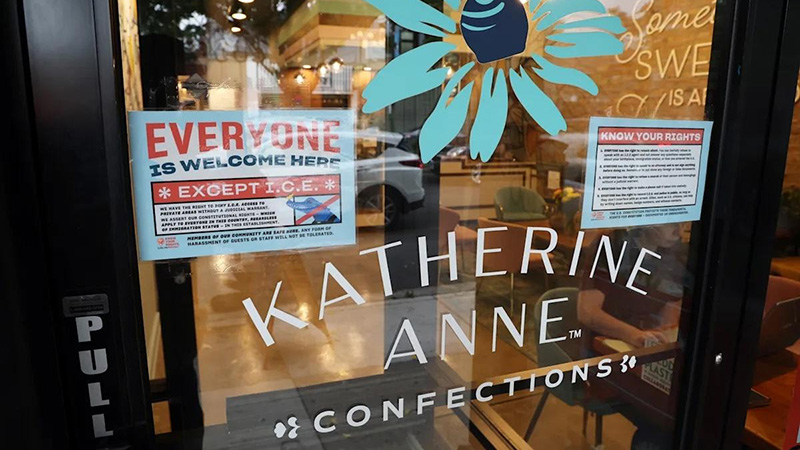
As such, Chicagoans are doing what they can to protect their communities from this federal imposition. The Chicago tribune reported that small businesses across the city are posting signs reading “Everyone is welcome here, except I.C.E.”—a firm message that the community stands together against fear and divisive legislation. At Katherine Anne Confections in Irving Park, owner Katherine Duncan hung one of those signs on her door—a simple act of defiance in a time of uncertainty. As federal immigration raids increase across Chicago, local storefronts are transforming into informal sanctuaries.
From Logan Square to Pilsen, cafés, coffee shops and small restaurants are taping up the same bold message. At Cafe Tola, owner Victoria Salamanca says her decision was grounded in both courage and care—choosing to make her business a place of refuge for her predominantly Latino staff and neighborhood. Meanwhile, at Botanical Cafe in Lakeview, the message has expanded: posters titled “Know Your Rights” in English and Spanish now line the windows, a clear reminder that immigrants are seen, valued, and supported.
These signs were created by the Immigrant Legal Resource Center and have spread rapidly—each installation a business owner taking a stand, each neighborhood showing up, each citizen declaring: fear will not win. In a city marked by targeted enforcement efforts, these acts of community solidarity matter. For Duncan, her sign was more than a symbol. “If a thousand people did this, we might be in a different place,” she said. What she envisions is a network of small businesses and neighbors linking arms—each sign a node in a larger shield of mutual support.
In an era of contentious debates over immigration policy and sweeping enforcement directives, the importance of unity cannot be overstated. The Chicago Tribune has emphasized that newspapers and communities should “embrace the diversity of people and perspectives in our community. We are dedicated to the future of the Chicago region.” This emphasis on inclusivity underscores the role of local solidarity in countering legislation that threatens to exclude or marginalize.
When politically charged laws begin to erode trust between citizens and government—or between neighbors—solidarity becomes a form of resistance. The signs in Chicago’s windows are not just statements of welcome; they are declarations of self-governance, of community agency in the face of legislation that would divide. In neighborhoods from Pilsen to Lakeview, business owners are saying: we have each other’s backs; we will not be divided by fear.
Solidarity also reduces vulnerability. Immigrant communities—already courageous in navigating daily challenges—face heightened risks when enforcement escalates. By marking storefronts as safe havens and broadcasting messages of inclusion, Chicago’s small-business owners strengthen neighborhoods’ resilience.
These acts connect directly to policy debates. Divisive legislation often relies on isolation—of communities, of individuals, of different ethnic or social groups. By contrast, when neighbors unify around a message of collective welcome, they reclaim power. In this moment, Chicagoans are showing that compassion can be louder than intimidation. From a pastry shop in Irving Park to cafés in Latino neighborhoods, the message is the same: We stand together. Welcome is not just a word on a sign—it’s a living truth. And as these businesses demonstrate, community solidarity is perhaps the strongest safeguard against legislation built on division.
#ImmigrantRights #ChicagoSolidarity #SafeSpaces