

How to Take and Understand Your Blood Pressure at Home
Taking your blood pressure at home is one of the most effective ways to track your cardiovascular health. However, a single misplaced cuff or a tense posture can artificially spike your numbers by as much as 10 to 40 mmHg. To get numbers both you and your doctor can trust, consistency, proper technique, and knowing how to read the results are essential.
The Step-by-Step Technique
Following a precise sequence before and during your reading eliminates the most common errors that lead to inaccurate results.
1.Prepare Your Body:30 Minutes Prior.
Do not eat, exercise, smoke, or consume caffeine for at least 30 minutes before taking a reading. Ensure you empty your bladder entirely before sitting down, as a full bladder can add up to 10 mmHg to your result.
2.Rest and Relax:3–5 Minutes Prior.
Sit quietly in a comfortable chair for 3 to 5 minutes without distractions—avoid checking your phone, watching TV, or talking. Let your body reach a true resting state.
3.Correct Your Posture:During the Reading.
Sit upright with your back firmly supported by the chair. Keep your feet flat on the floor with your legs uncrossed. Do not cross your ankles or let your feet dangle.
4.Position the Cuff:During the Reading.
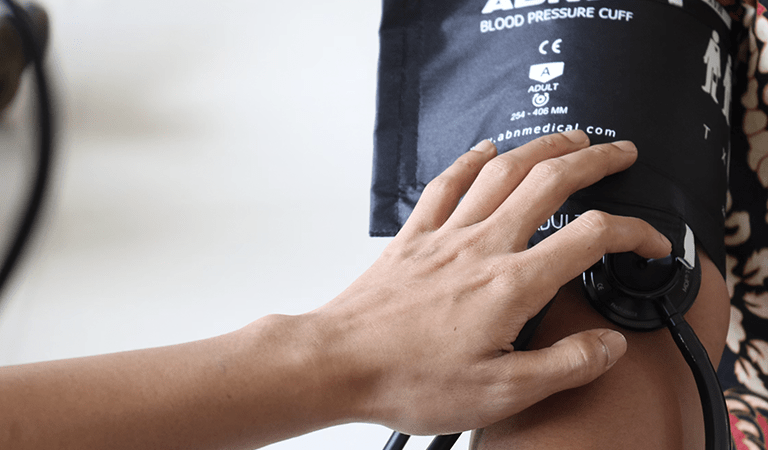
Place the blood pressure cuff on your bare upper arm, roughly 1 inch above the bend of your elbow. The cuff should be snug but comfortable—you should just be able to slide two fingertips underneath it.
5.Support Your Arm:During the Reading.
Rest your arm on a table or flat desk so that the cuff sits level with your heart. Keep your palm facing upward, remain completely still, and do not speak while the machine is actively measuring.
The Rule of Two: Always take two readings spaced 1 to 2 minutes apart. Jot down both numbers and average them. If your first reading feels unusually high, the second reading after another minute of calm breathing is often more reflective of your actual resting blood pressure.
Decoding Your Numbers: Systolic vs. Diastolic
When your monitor finishes inflating, it displays two primary numbers, usually written as a fraction (like 120/80 mmHg). The unit “mmHg” stands for millimeters of mercury, the standard medical measurement for pressure.
- Systolic (Top Number): This measures the maximum pressure your blood exerts against your artery walls when your heart beats (contracts) to push blood out to the rest of your body.
- Diastolic (Bottom Number): This measures the pressure in your arteries when your heart rests between beats, filling with blood.
Blood Pressure Categories
According to the American Heart Association (AHA), adult blood pressure readings generally fall into five distinct categories.
| Category | Systolic (Top) | Diastolic (Bottom) | |
| Normal | Less than 120 | and | Less than 80 |
| Elevated | 120 to 129 | and | Less than 80 |
| Stage 1 Hypertension | 130 to 139 | or | 80 to 89 |
| Stage 2 Hypertension | 140 or higher | or | 90 or higher |
| Hypertensive Crisis | Higher than 180 | and/or | Higher than 120 |
Note: If your systolic and diastolic numbers fall into two different categories, your overall classification matches the higher category. For example, a reading of 118/85 mmHg is classified as Stage 1 Hypertension because the diastolic number is between 80 and 89.
Top Recommended Blood Pressure Monitors
When choosing a home monitor, look for devices that have been clinically validated by independent organizations such as the American Medical Association (AMA) or Stride BP. By default, upper arm cuffs are highly recommended over wrist monitors, as wrist models are significantly more sensitive to body position and movement.
| Brand & Model | Best For | Standout Features |
| Omron 3 Series (Upper Arm) | Best Value & Simplicity | Trusted, no-frills accuracy with one-touch operation and a budget-friendly price point. |
| Oxiline Pressure XS Pro | Best Overall Tech | Features an ultra-bright OLED display and embedded VIBRA™ TX motion sensors to flag bad readings caused by movement. |
| Withings BPM Connect | Best Smart Features | Wi-Fi and Bluetooth enabled, automatically syncing readings to a secure app to share trends directly with your medical provider. |
| Omron Platinum / 7 Series | Best Advanced Tracking | Premium upper-arm monitoring capable of checking for irregular heartbeats (like AFib) during regular tracking. |
Disclaimer: This article is for informational purposes only. For medical advice, diagnosis, or interpretation of your blood pressure numbers, please consult a qualified healthcare professional. If you hit a reading in the Hypertensive Crisis range, wait five minutes and test again. If it remains that high, contact your doctor immediately.
#HeartHealth #BloodPressure #HomeHealthCare