Overview: The Mississippi Freedom Vote of 1963 mobilized over 80,000 Black citizens in a historic parallel election that exposed systematic disenfranchisement and paved the way for modern civil rights protections. As November 3 approaches, that legacy directly echoes through Scott Colom’s historic bid for the U.S. Senate in Mississippi, reminding eligible voters that casting a ballot remains the ultimate safeguard against political exclusion.
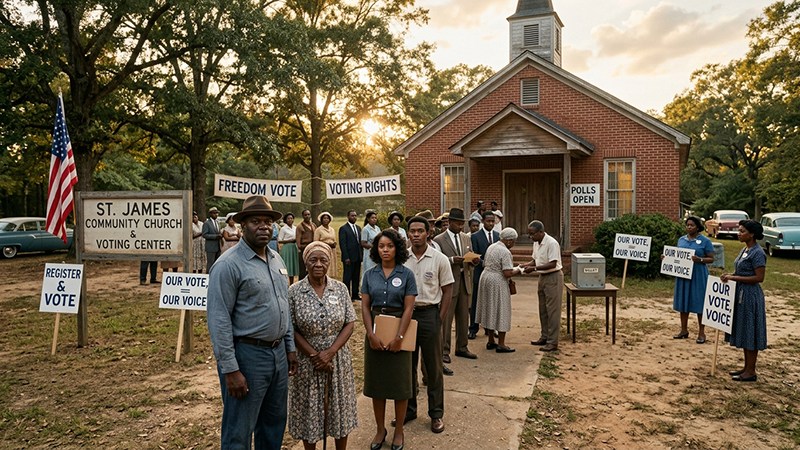
Sixty-three years after 80,000 Black Mississippians staged a mock election, the fight for fair representation lands on the November 3 ballot.
Mississippi Freedom Vote: The Civil Rights Legacy Behind Every Ballot
The Mississippi Freedom Vote was a 1963 civil rights campaign in which more than 80,000 Black Mississippians cast symbolic ballots to prove they wanted, and deserved, a voice in their government. As November 3 approaches, that history is a reminder that the right to vote was not freely given to everyone. It was demanded, defended, and secured through the courage of ordinary citizens who risked their livelihoods, their freedom, and their lives to ensure their voices would count.
What Was the Mississippi Freedom Vote?
October marks the 63rd anniversary of Mississippi’s Freedom Vote, the historic 1963 civil rights initiative that challenged the systematic exclusion of Black citizens from the electoral process. At a time when discriminatory registration requirements, intimidation, and violence prevented countless African Americans from voting, organizers created an alternative election to demonstrate that Black Mississippians wanted, and deserved, a voice in their government. More than 80,000 people participated, sending a powerful message to the nation about the scale of disenfranchisement and the depth of the demand for change.
How Did Medgar Evers Shape the Voting Rights Movement?
Medgar Evers was the Mississippi NAACP field secretary who devoted his life to civil rights and voter registration, and his work helped lay the foundation for the Freedom Vote. The campaign emerged from the same struggle for equality that defined his career. Evers understood that political participation was essential to challenging discrimination and holding public officials accountable. On June 12, 1963, he was assassinated outside his Jackson home, a devastating reminder of the dangers faced by those demanding equal rights. His work, however, did not end with his death.
Who Led the Freedom Vote Campaign?
The Freedom Vote featured Aaron Henry, a Black pharmacist and civil rights leader who ran for governor, with white minister Edwin King as his running mate. Their campaign challenged Mississippi’s political establishment and helped lay the groundwork for subsequent efforts to secure fair representation. Henry and King demonstrated that democracy cannot fulfill its promise when an entire segment of the population is shut out of the political process.
How Does This History Connect to Mississippi Politics Today?
That history resonates directly in Mississippi’s current U.S. Senate race, where Scott Colom, a Black Democrat, is seeking a seat in a state where no Black Mississippian has served in the Senate since Reconstruction. Colom’s candidacy unfolds against a backdrop of generations fighting to overcome barriers to political participation. The circumstances are different from those of 1963, but the fundamental principle remains the same: every eligible citizen deserves the opportunity to participate in choosing who represents them.
Why Does Voting Still Matter?
Voting remains one of the most direct ways citizens can help shape public policy, select representatives, and influence decisions affecting their families and communities. Elections determine who exercises public authority and which priorities receive attention. A ballot cannot guarantee that every concern will be addressed, but not voting relinquishes an opportunity to have a say in the outcome.
How Can You Prepare to Vote on November 3?
As November 3 approaches, make a plan. Confirm your voter registration, learn the voting rules where you live, review the candidates and issues, and determine when and where you can cast your ballot. If early voting or mail voting is available where you live, consider those options to ensure your vote is counted.
The men and women who participated in Mississippi’s Freedom Vote understood that democracy requires participation. Honor their legacy. Exercise your right. Make your voice count. Vote on or before November 3.
Frequently Asked Questions
Q: How many people participated in the Mississippi Freedom Vote?
A: More than 80,000 Black Mississippians cast ballots in the 1963 Freedom Vote, an unofficial election organized to prove that Black citizens wanted full access to the electoral process despite being systematically excluded from it.
Q: When did Medgar Evers die, and why is it significant to voting rights history?
A: Medgar Evers was assassinated on June 12, 1963, outside his Jackson home. His death underscored the extreme risks civil rights workers faced while organizing for voter registration and equal political participation in Mississippi.
Q: Who ran in the 1963 Mississippi Freedom Vote?
A: Aaron Henry, a Black pharmacist and civil rights leader, ran for governor in the Freedom Vote, with white minister Edwin King as his running mate. Their campaign challenged the legitimacy of Mississippi’s exclusionary political system.
Q: Has a Black Mississippian served in the U.S. Senate since Reconstruction?
A: No. No Black Mississippian has served in the U.S. Senate since the Reconstruction era, a history that frames Scott Colom’s current Senate candidacy as part of an ongoing struggle for political representation.
#VotingRights #FreedomVote #MakeAPlanToVote