
Experts outline emerging opportunities, cybersecurity requirements and strategies for strengthening the Midwest defense industrial base
[O’Fallon, Ill. / Sept. 10, 2026] – Manufacturers seeking to expand their role in the defense sector have significant opportunities ahead, but success will require preparation, relationship-building and a proactive approach to cybersecurity and compliance, according to experts who spoke during the 2026 Global Aerospace Summit held in O’Fallon, Ill., Aug. 19 and 20.
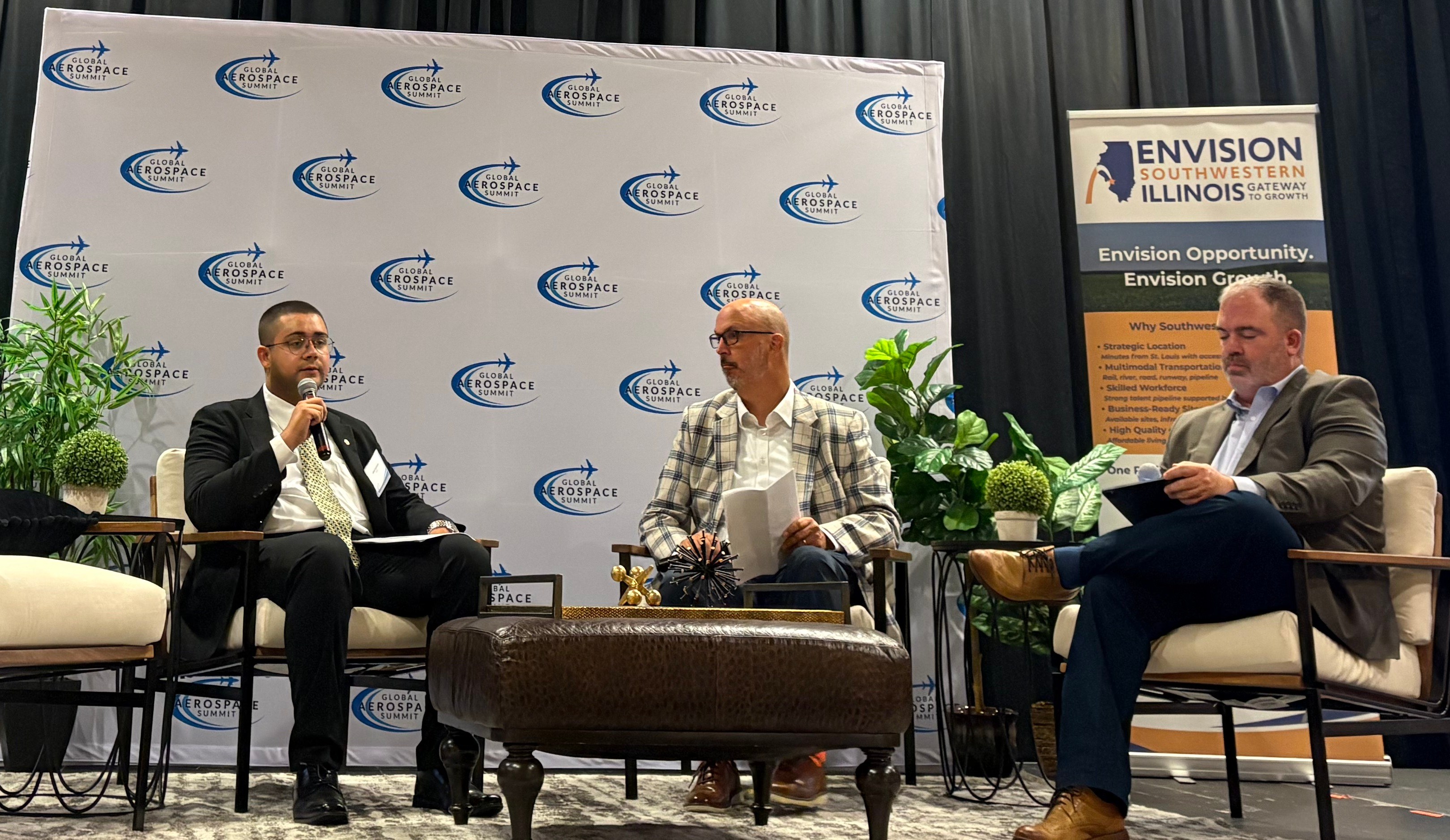
The session, titled From Compliance to Competitiveness: Navigating Today’s Defense Landscape, featured Nicholas Santana, board member of the National Defense Industrial Association (NDIA) Iowa-Illinois Chapter and President of Ultio Crati, Inc., and Jason Sullivan, Director of Sales and Marketing at Systems Service Enterprises (SSE). Their discussion focused on how businesses can position themselves to pursue defense contracts, strengthen their competitiveness and capitalize on growing demand throughout the defense industrial base. It emphasized that opportunities are expanding, particularly for companies willing to understand government procurement processes and timelines and invest in long-term readiness.
The panelists noted that evolving national security priorities, modernization efforts and expanding production requirements are creating new opportunities for suppliers throughout the defense ecosystem. According to Santana, businesses should focus on aligning their capabilities with mission-critical programs that have long-term funding commitments and sustained demand. He also highlighted the opportunities available in logistics, sustainment and advanced manufacturing, particularly in regions with strong industrial and transportation assets.
“Military buys everything; the government buys everything,” Santana said. “The biggest opportunity moving forward is aligning yourself with the right mission critical programs or programs of record.”
The panelists both stressed that businesses should not wait for opportunities to appear, but instead actively build relationships with government procurement officials, large prime contractors and industry organizations that can help connect suppliers to emerging needs.
A central theme of the discussion was the growing importance of cybersecurity compliance, particularly as implementation of Cybersecurity Maturity Model Certification (CMMC) requirements advances across the defense sector. Rather than viewing compliance solely as a regulatory obligation, Sullivan encouraged businesses to see it as a growth strategy that can create new revenue opportunities.
“There’s a whole other group of DOD contractors that are saying, ‘I’m going to get compliant so I can be better positioned for new contracts,’” Sullivan said. “They’re going to get ready faster and they’re going to be ready for the business.”
He said prime contractors are increasingly evaluating supply chains through a risk-management lens and looking for suppliers that can demonstrate compliance before bidding opportunities arise. According to Sullivan, organizations that treat compliance as simply an IT issue risk falling behind competitors that have embraced it as a business-wide responsibility.
“It is a mind shift for the company,” he said. “It’s not an end goal. You have to change your culture.”
The panelists cautioned attendees that defense contracting requires preparation well before an opportunity appears. Sullivan explained that historic approaches related to compliance that were built on self-attestation are evolving toward greater verification and accountability. “CMMC now puts authority, responsibility, and accountability to those controls,” Sullivan said. “Now you have to prove it.”
He warned that businesses that delay action could find themselves excluded from opportunities before they even begin discussions with a prime contractor. “Don’t procrastinate on this,” Sullivan said. “Be intentional. Be patient. Get your scoping done early.”
Sullivan also described cybersecurity readiness as a business issue rather than a technical exercise. “I don’t see cybersecurity as a barrier,” he said. “I see procrastination as a barrier.”
While obtaining registrations, certifications and compliance credentials is important, both speakers emphasized that relationships remain critical to success. Santana encouraged attendees to engage with contracting offices, small-business outreach organizations, military installations and industry associations to better understand upcoming opportunities and requirements. He also urged new entrants not to hesitate to seek advice from organizations already active in the defense marketplace.
“Don’t be afraid to ask questions if you’re new to this,” Santana said. “A lot of people are more than willing to explain the acronyms, the processes.”
Both speakers pointed to organizations such as NDIA, Association of the United States Army (AUSA), National Defense Transportation Association chapters, APEX Accelerators and military small-business offices as valuable resources for companies looking to enter or expand within the defense market.
The session concluded with a call for greater collaboration among government agencies, industry partners, economic development organizations and manufacturers to help businesses anticipate future needs and reduce barriers to participation in order to strengthen the defense industrial base in the Midwest. Likewise, Sullivan emphasized that the region should actively pursue opportunities created by growing aerospace and defense activity. “We need to play in that space,” he said. “We need to play very, very aggressively.”
The panel reinforced a key takeaway of the Global Aerospace Summit: the St. Louis region and broader Midwest possess the manufacturing expertise, logistics capabilities and workforce needed to capture a larger share of defense-related investment. However, success will depend on companies acting now to strengthen capabilities, improve compliance readiness and position themselves as trusted partners within an increasingly competitive defense supply chain.
The second annual Global Aerospace Summit brought together aerospace manufacturers, suppliers and leaders in military, cargo movement, transportation, economic development and related industries for a two-day program focused on innovation, collaboration and growth. The event was presented by the Leadership Council Southwestern Illinois; Madison County, Illinois; St. Clair County, Illinois, and Bi-State Development’s St. Louis Regional Freightway. To learn more, visit https://leadershipcouncilswil.