

Overview: Black and Hispanic workers make up roughly 32 percent of the American workforce, but they hold only 7 to 8 percent of high-tech jobs and fewer than 5 percent of cutting-edge AI engineering roles. This persistent underrepresentation is driven by early K-12 STEM funding disparities, exclusionary Ivy League recruiting pipelines, self-replicating referral networks, and algorithmic screening bias that systematically filters out non-traditional candidates. Because minority workers are heavily concentrated in routine support roles facing rapid automation displacement, failing to move Black and Brown talent into technical creation and model development widens the racial wealth gap and bakes dangerous algorithmic bias into artificial intelligence systems.
Articulated Insight – “News, Race and Culture in the Information Age”
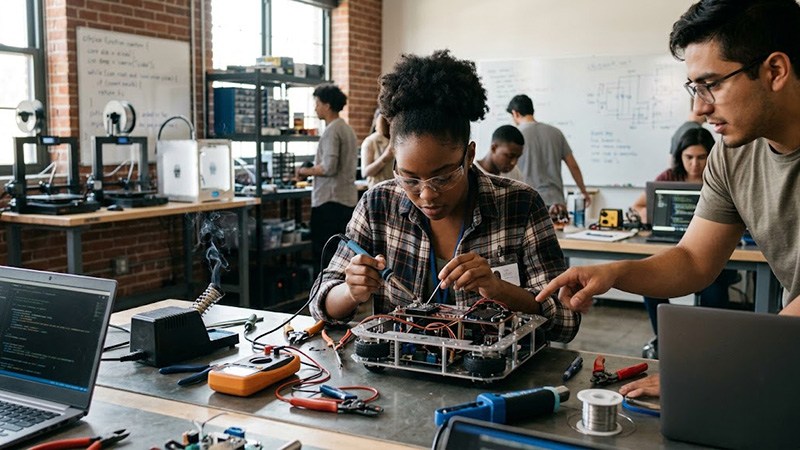
How Ivy League gatekeeping, biased resume bots, and broken promotion ladders are shutting workers of color out of the modern AI gold rush.
Big tech loves to preach about shaping what comes next, but when you look past the glossy keynote presentations, you run straight into a glaring demographic wall.
Black and Hispanic workers make up roughly 13 percent and 19 percent of the entire American workforce. Yet inside the high-tech industry, those numbers collapse to about 7 or 8 percent. Step inside the rooms where cutting-edge artificial intelligence, machine learning, and core software engineering actually happen, and the picture looks even worse. Over two-thirds of major tech outfits report having fewer than 5 percent Black personnel. The few minority employees who do get hired are heavily steered toward customer support desks or low-tier technical support instead of the high-earning builder roles that shape modern products.
This divide did not happen by chance. It is the predictable outcome of early educational barriers, lazy hiring habits, and corporate cultures that wear people out. Fixing it is not about charity. It is about business survival, wealth creation, and keeping tech safe and functional for everyday users.
The Traps at the Front Door
The roadblocks start years before anyone submits a resume. Public schools in predominantly Black and Brown neighborhoods rarely get the funding needed to run robust coding clubs, advanced placement computer science classes, or competitive robotics programs. Students grow up without hands-on access to the tools shaping the modern economy.
Even when minority students beat the odds and enroll in college STEM programs, the pipeline springs massive leaks. The attrition rate is brutal. High tuition costs, zero safety net, lack of mentorship, and institutional isolation force many brilliant students to drop out or switch majors.
Then corporate recruiting steps in to make things harder. Tech giants pour billions into recruiting at a tiny circle of Ivy League and private engineering campuses where minority enrollment has always been low. They systematically overlook Historically Black Colleges and Universities and Hispanic-Serving Institutions, even though these schools graduate massive numbers of sharp, ambitious technical minds.
Once you try to apply, you run into the friend-of-a-friend filter. Tech relies heavily on internal employee referrals. If your current staff is overwhelmingly white and Asian, your referral pool ends up looking identical. Throw in whiteboard coding tests and automated resume-screening bots that favor specific educational backgrounds, and qualified candidates get quietly tossed in the trash before a real human ever sees their work.
In the AI sector, this gatekeeping gets even more intense. Labs demand advanced degrees from a handful of elite institutions, keeping underrepresented creators locked completely out of early model training.
Culture Shocks and Stolen Ladders
Getting past the front door is only half the battle. Staying inside is just as exhausting. Black and Hispanic professionals often navigate subtle microaggressions, skewed performance reviews, and workplaces where being yourself feels dangerous. Without senior managers and directors who share their lived experiences, young workers end up navigating office politics completely alone.
Then there is the broken rung on the ladder. While companies occasionally hire a few minority candidates for junior roles to boost their numbers, mid-level and executive promotions stall out. People watch less-qualified peers get groomed for leadership while their own careers hit a ceiling. Eventually, burnt out and overlooked, top talent leaves the industry entirely.
What Happens When Everyone in the Room Looks the Same
When only one narrow group of people designs the code that runs the world, things break fast.
First, algorithmic hiring tools inherit old human biases. When researchers at the Stanford Institute for Human-Centered Artificial Intelligence looked at four million real job applications across 150 companies, they spotted a serious problem. The automated hiring tools favored the same traditional profiles, creating an adverse impact against 26 percent of Black candidates. When teams lack variety, they build automated tools with massive blind spots.
Second, better teams make better tech. In an experiment studying generative models like ChatGPT, researcher Miles Yang discovered that embedding inclusive evaluation instructions directly into AI systems doubled the selection rates for marginalized candidates. When people build tools with awareness, the software stops acting like a bouncer and starts evaluating real competency.
Third, everyday livelihoods are on the line. Research from the Urban Institute shows that historical job patterns pushed Black and Brown workers into customer service, office administration, and routine support tasks. These are the exact jobs artificial intelligence is wiping out first. If minority workers are only on the receiving end of tech disruption rather than building the machines, the wealth gap will explode into an unbridgeable canyon.
Real Moves That Change the Numbers
Closing this divide requires clear action from the classroom to the boardroom:
Invest in early classrooms and alternative talent: Federal and state leaders must fund K-12 computer science labs in underfunded districts. Meanwhile, tech firms need to set up direct recruiting pipelines at HBCUs and HSIs while treating bootcamps and community colleges as legitimate talent pools.
Tear down pedigree bias and audit automated screeners: Stop treating elite diplomas as the only proof of talent. Shift entirely to portfolio-based skill testing, reward employees who refer diverse candidates, and run regular outside audits on all AI hiring bots.
Fix the promotion track: Set up direct executive sponsorship where senior leaders are evaluated on whether junior minority talent moves up. Pay the leaders who run internal Employee Resource Groups for the emotional and organizational heavy lifting they do.
Fund minority founders and expand broadband: Real wealth happens through ownership. Institutional investors need to stop sending 98 percent of venture capital to the same demographic and start backing Black and Hispanic entrepreneurs. At the same time, expanding high-speed internet and hardware access across urban centers and rural communities ensures nobody gets left behind.
Bringing Black and Brown talent into the engine room of AI is not about ticking a corporate box. It protects the software from dangerous bias, keeps millions of workers from being displaced by automation, and ensures everyone gets a fair shot at the greatest wealth creation event of our lifetime.
Sources and Case Studies
Pew Research Center: Diversity in STEM Fields
The Kapor Center: The Leaky Tech Pipeline Framework
https://www.kaporcenter.org/the-leaky-tech-pipeline
U.S. Equal Employment Opportunity Commission: Diversity in High Tech
https://www.eeoc.gov/special-report/diversity-high-tech
Stanford HAI: Auditing Algorithmic Bias and Monoculture in Hiring
https://hai.stanford.edu/research
Miles M. Yang: Inclusive AI Design and Evaluation Models
Urban Institute: Artificial Intelligence, Occupational Segregation, and the Future of Work
https://www.urban.org/research/publication/how-ai-could-affect-black-workers
NAACP Black Tech Ecosystem
Jobs for the Future: Center for Artificial Intelligence and the Future of Work
https://www.jff.org/idea/center-for-artificial-intelligence-and-the-future-of-work
#BlackTech #AIBias #DiversityInTech