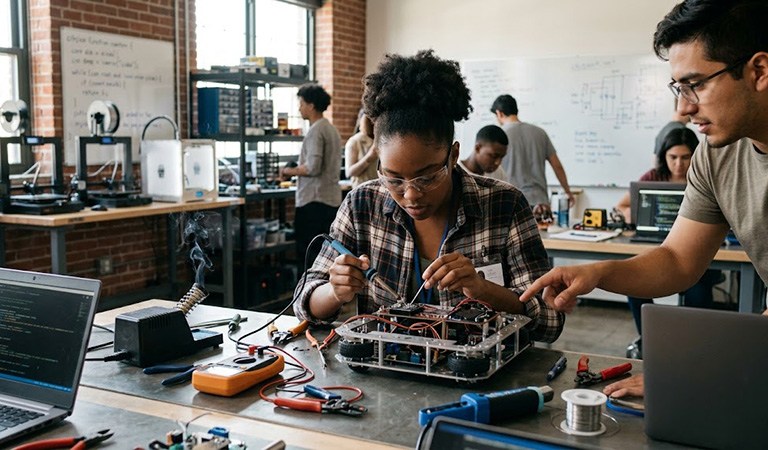

Overview: Artificial intelligence is transforming every sector into a tech industry, yet Black women still hold only about 2% of computing jobs. Black Girls Code is actively countering this imbalance by training young Black women to become architects, rather than passive users, of emerging AI technology. Through hands-on coursework in machine learning, algorithmic bias prevention, and practical coding, the organization equips the next generation with the technical mastery and leadership skills required to shape ethical, inclusive systems across global business.
How Black Girls Code is equipping young women of color with the skills, ethics, and leadership to shape the emerging artificial intelligence economy.
“The key thing that everybody needs to know is that every industry today is now a tech industry. We have to think about technology as shaping every educational Subject, From reading and writing to health to history and social studies, including all of the STEM subjects, and we have to start teaching the basic tech concepts that shape that area of knowledge,” says Evelyn Diaz, VP of Workforce Development for Black Girls Code.
Black Girls Code (BGC) is on a mission to transform the tech industry by preparing one million black and brown young women to become leaders in technology by 2040. The nonprofit organization is tackling a glaring disparity: only 2% of the tech workforce is composed of Black and Brown women. Diaz believes the stakes are high. “We’re in the middle of a seismic shift, and our girls must be on the field, not just watching from the sidelines,” she said.

VP of Workforce Development- Evelyn Diaz
The organization operates on three essential pillars: technical fluency, hands-on experience, and confidence. Through these, BGC empowers participants as young as seven to learn coding languages like Python and JavaScript, and to explore advanced concepts such as natural language processing and computer vision. “We tailor our curriculum to align with their passions, allowing them to solve societal challenges while building practical skills,” Diaz explained.
In recent years, BGC has expanded its programming to address the rise of artificial intelligence. This summer, students participated in a Call for Code challenge with IBM, developing solutions that harness AI for social good. The winning project, Study Buddy, is a chatbot that connects users to study resources and scholarship opportunities. Diaz praised their ingenuity, saying, “When young people see technology as relevant to their lives, they create stunning, impactful projects.”

BGC’s commitment to workforce development extends to partnerships with industry leaders like ServiceNow and Microsoft. These collaborations provide participants with job readiness opportunities, including internships and pre-apprenticeship programs. “Our partnerships ensure that our girls aren’t just learning in theory but applying their skills in real-world settings,” Diaz said. The organization’s partnership with MIT has also allowed BGC to incorporate cutting-edge AI curricula, preparing participants for the rapidly evolving job market.
The importance of this work is fueled by global trends. According to the World Economic Forum’s 2023 Future of Jobs Report, automation could displace 85 million jobs by 2030, but it will also create 97 million new roles. However, many young people feel unprepared for an AI-enabled workforce. “That gap in readiness is a call to action for us,” Diaz said. “We have to prepare Black and Brown women for the opportunities of tomorrow.”
BGC’s impact is growing. From its initial base in eight U.S. cities, the organization plans to double its reach by 2025. Diaz emphasized the need for government and corporate partnerships to achieve scale. “We’re looking to partner with tech companies and public institutions that share our vision. The goal is to ensure that every Black and Brown girl with the desire to enter tech has a pathway to do so.”
The organization also plans to explore global initiatives, starting with the Caribbean. Diaz noted the unique opportunities in the region, where partnerships with U.S.-based companies could provide job opportunities without barriers. “Our programs have the potential to thrive internationally, but there’s still so much untapped potential here in the U.S.,” she said.
Despite the road ahead, Diaz remains optimistic. “We have more access to the next generation of Black and Brown women technologists than anyone else. Our job is to connect this talent with opportunities and build a community that fosters belonging and growth,” she said. With its ambitious roadmap and commitment, Black Girls Code is preparing young women for the future—and shaping an inclusive future for the next generation.
https://youtu.be/rzdZjkttBag?si=wCEhllWy5WSANz-J
#blackgirlscode #airediness #diversityintech #evelyndiaz #technology #microsoft #aiworkforce
#BlackGirlsCode #AIRevolution #WomenInTech