
Overview: With roughly 51 pedestrians severely injured or killed on local streets each year since 2021, Kansas City has launched SafeAcross KC. The city is placing high-contrast, life-size metal cutout figures named “Mr. Walker” alongside traditional crosswalk markers at 11 high-crash intersections to disrupt driver visual fatigue, force motorists to slow down, and curb traffic violence across major urban corridors.
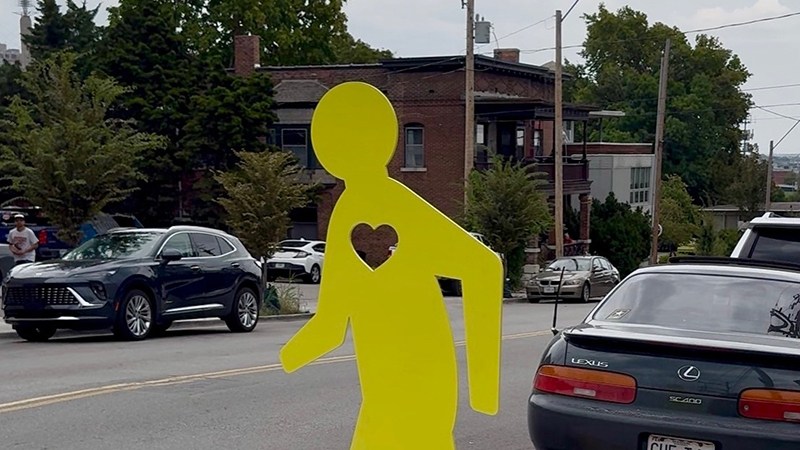
Facing a relentless wave of pedestrian deaths, city officials are ditching standard warning signs for bold roadside metal art designed to shock drivers into braking.
Kansas City Drivers Keep Hitting Pedestrians, and City Hall’s Answer Is Metal Statues
Kansas City has a pedestrian crisis, and the statistics reveal a troubling reality.
Since 2021, the city has recorded an average of 51 crashes every single year involving pedestrians that resulted in death or debilitating injuries. That is roughly one catastrophic incident every week on local streets. For years, the default municipal toolkit has stayed predictable: fresh white stripes on the asphalt, standard yellow signs, and public safety lectures.
The crash numbers barely budged.
Now, City Hall is shifting tactics from quiet bureaucracy to high-visibility public design. Through a new initiative called SafeAcross KC, the city plans to disrupt driver behavior by introducing street art directly onto the pavement.
Enter “Mr. Walker”
The centerpiece of this safety push is not a new speed camera or a complex ticket system. Instead, the initiative relies on life-size, brightly painted metal sculptures of a walking figure dubbed “Mr. Walker.”
Starting this month, crews are installing these high-contrast silhouettes adjacent to crosswalks at 11 high-risk locations throughout the urban core, with more planned in subsequent phases.
The strategy behind the figures targets driver psychology:
- Pattern Disruption: Drivers tune out familiar, uniform municipal signs. A human silhouette placed directly on the curb line forces a double-take, triggering an automatic tap on the brakes.
- Elevated Crosswalk Visibility: Placing vibrant physical installations marks pedestrian territory far more aggressively than flat road paint, especially in complex commercial corridors.
- Dual Accountability: The program pairs installations with pedestrian educational initiatives, urging walkers to utilize designated crossings while demanding that drivers yield the right-of-way.
Scaling an Out-of-Town Experiment
The SafeAcross model did not originate in Kansas City. It was first road-tested in Springfield, Missouri. By adopting and expanding the framework with support from the Missouri Department of Transportation (MoDOT), Kansas City becomes the largest metropolitan area to bet on this visual design approach.
The city hosted a public demonstration at the high-traffic intersection of Troost Avenue and East 31st Street. Mayor Quinton Lucas, 4th District Councilmember Eric Bunch, Public Works Director Jason Waldron, and Major Jason Asper from the Kansas City Police Department gathered to introduce the rollout and outline enforcement expectations.
Transforming urban infrastructure demands continuous funding and political capital, but changing cultural habits behind the wheel requires visual disruption. If brightly painted cutouts can force drivers to look up from their dashboards and yield, Kansas City may find that creative public art delivers the protection standard regulatory signs failed to provide.
#KCTraffic #PedestrianSafety #SafeAcrossKC