

Articulated Insight: News, Race, and Culture in the Information Age
Articulated Insight: News, Race, and Culture in the Information AgeOverview: National economic indicators like a 4.2 percent unemployment rate, 3.4 percent CPI inflation, and climbing interest rates fail to tell the entire human story. Disrupted energy shipping routes and supply chain tariffs hit operating budgets and household expenses directly, while aggressive capital spending on AI infrastructure often outpaces internal workforce investment. Because the K-shaped recovery produces vastly divergent financial realities under the same corporate roof, organizational leaders must look beyond headline statistics to prioritize talent mobility, wage equity, and debt sustainability.

Understanding power, policy, and representation in a divided Washington after a historic election
I am celebrating this blue wave.
I am celebrating every voter who stood in line, every candidate who stepped into the arena, and the historic firsts that remind us how much possibility still lives in this country. With Democrats securing majorities in both the House and the Senate, power in Washington has shifted.
Now comes the question every working family and business owner is asking: What does this actually mean for my day-to-day life?
Can we expect financial relief? Can Congress check the president? Will policy shift overnight?
These are sensible questions. People are anxious about their household budgets, their companies, and their civil rights. You do not need a political science degree to get straight answers. Let us break down how Congress works, what a divided government can deliver, and what business leaders must watch next.
Historic Firsts in American Leadership
Before diving into legislative mechanics, we must honor the breakthroughs.
- Keisha Lance Bottoms made history as Georgia’s first Black woman governor.
- Deb Haaland won election as New Mexico’s first Native American woman governor.
- Peggy Flanagan enters the United States Senate as the chamber’s first Native American woman senator.
- Abdul El-Sayed joins the Senate as its first Muslim member.
- Chris Pappas won his race as the Senate’s first openly gay man.
Having spent decades championing executive leadership and workplace inclusion, I see these victories as clear proof that Americans are broadening their definition of who belongs at the decision-making table.
We should applaud their credentials and celebrate the ceilings they broke. At the same time, representation is step one. What leaders do with power is what counts. Being the first opens the door; delivering equitable economic growth and community support keeps it open.
How Congress Works: The Basics of Passing Federal Laws
To track what happens next, let us revisit the basics of how our federal government functions.
- Congress consists of two bodies: the House of Representatives and the Senate.
- The House of Representatives: 435 voting members, allocated by state population. Every representative faces election every two years. Most House measures advance with a simple majority of 218 votes.
- The Senate: 100 members, two for each state regardless of size. Senators serve six-year terms, with roughly one-third of the chamber up for election every two years.
For any federal bill to become law, both chambers must pass identical text and send it to the White House.
A Democratic majority can draft and pass bills, but President Donald Trump holds veto power. Overriding a presidential veto requires a two-thirds supermajority vote in both the House and the Senate. A slim legislative majority cannot clear that hurdle alone.
Take prescription drug pricing. Passing a cost-reduction bill through the House is one hurdle. Clearing the Senate is another. If the White House vetoes the measure, lawmakers need a massive bipartisan coalition to override it. That reality explains why campaign pledges face sharp headwinds once governing starts.
Senate Filibuster Rules and Budget Reconciliation
The Senate has a distinct hurdle you hear about daily: the filibuster.
Under current Senate rules, closing debate on standard legislation requires 60 votes. Final passage only requires a simple majority of 51. Those are two separate tests. A party can hold enough votes to pass a bill, yet still lack the 60 votes required to bring it to the floor.
Budget reconciliation offers a major procedural exception. This special process allows specific spending, revenue, and federal debt limit legislation to pass the Senate with a simple majority. Even then, strict procedural rules apply, and the final bill still lands on the president’s desk for signature or veto. You cannot push an entire party agenda through reconciliation.
Real Powers of the New Congressional Majority
A change in majority rule still alters Washington in fundamental ways.
Subpoena and Oversight Authority
House and Senate majority leaders set committee agendas, run oversight hearings, question agency heads, and track federal spending. Conducting investigations does not require presidential approval. While legal skirmishes over document requests happen, committee gavels give lawmakers direct leverage.
The Power to Block Legislation
Controlling the floor means the majority decides which bills never see the light of day. For communities and companies concerned about rollbacks to consumer protections, workplace equity, or safety nets, stopping harmful legislation is a tangible victory.
Judicial and Executive Confirmations
The Senate alone handles presidential nominations for federal judges, Cabinet secretaries, and independent regulatory agencies. A Senate majority can vote down nominees it considers unqualified. Because federal judges serve lifetime appointments, that confirmation power shapes national policy for generations.
The Power of the Purse
Congress controls federal appropriations. Deciding how tax dollars are spent gives legislative leaders deep bargaining power. Under federal law, the executive branch cannot unilaterally refuse to spend dollars that Congress has lawfully allocated.
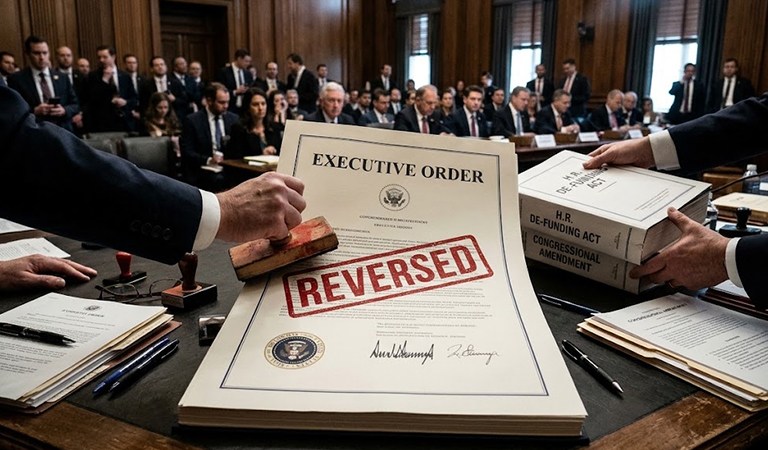
Executive Orders and the Balance of Power
The president commands substantial executive authority. White House executive orders can direct federal agencies and reset enforcement priorities.
However, executive orders are not blank checks. They must ground themselves in constitutional law or existing statutes enacted by Congress. Federal courts regularly review whether executive actions overreach, and those legal battles take time. A single election does not erase the check-and-balance system.
The timing matters just as much. The newly elected Congress formally convenes on January 3, 2027. The outgoing Congress remains seated until that date. Real shifts in committee leadership, staff hiring, and formal legislative drafting unfold across the first quarter of the year.
Strategic Guidance for Business Owners and Executives
For business owners, founders, and employers, political headlines must translate into operational strategy. Ask these three questions before adjusting capital allocation:
- Which policy proposals require new statutes versus executive branch rulemaking?
- Where do regulatory shifts face immediate federal court injunctions?
- How will federal spending debates impact government contracts, supply chains, and enterprise compliance?
Sound business development, hiring plans, and capital investments depend on verified policy facts, not political noise.
Hold elected leaders accountable to straightforward progress reports. If a workforce initiative or tax proposal stalls, we need to know whether the hold-up is procedural or a failure of political will.
Enjoy this historic moment. Study the leaders who represent your district and your state. Track how your representatives vote on local business growth, talent pipelines, and community health. We helped decide who holds the gavel; now we must actively guide how they use it.
Frequently Asked Questions About Congressional Power
What does a blue wave mean for everyday policy?
A blue wave puts Democrats in charge of the House and Senate legislative calendars, committee leadership, and investigative subpoenas. It prevents unilateral rollbacks of key programs, though major statutory changes still need White House approval or enough votes to override a veto.
Can Congress override a presidential veto with a simple majority?
No. Overriding a presidential veto requires a two-thirds supermajority vote in both the House of Representatives and the Senate.
When does the newly elected Congress take office?
Under the Twentieth Amendment to the United States Constitution, the newly elected Congress convenes at noon on January 3, 2027.
How does the Senate filibuster affect new legislation?
Most standard legislation requires 60 votes to end debate and overcome a filibuster before moving to a final, simple-majority passage vote. Budget reconciliation bills are the primary exception, requiring only 51 votes.
What specific legislative or regulatory shifts is your business preparing for as committee leadership changes? Let me know your top operational concerns, and let us map out the strategy together.

Pam McElvane, CEO, Author & Publisher, Promena Media
CEO | Master Coach | Board Governance Expert | Data Scientist | Strategist | Publisher
Pamela McElvane, MBA, MA, MCPC, is the CEO and founder of P&L Group, Ltd which has 3 key brands: Promena, 3I Research Institute & Diversity Learning Solutions, headquartered in Chicago, IL. Ms. McElvane has spent more than 25 years working with large and midsize companies providing insights and best practices, leadership and executive coaching, strategy, and organizational management.
About Promena (A P&L Group Brand)
Promena.Set the Standard (previously Diversity MBA) is a media, leadership, learning, research, and insights company dedicated to setting the standard for inclusion, equity, and performance. Through data-driven benchmarks, executive education, and thought leadership, Promena helps organizations turn inclusion from aspiration into a measurable business capability.
About Promena Insights
Promena Insights is the research and analytics division of Promena. It develops proprietary indices, benchmarks, and frameworks—including the Inclusive Leadership Index™ (ILI) and the Industry Inclusion Index (I³)—to measure inclusion maturity and guide evidence-based strategy for organizations and industries.
Contact for public speaking, coaching and leadership training opportunities:
833-362-2100 ext. 700 (Main) | pam@promenasetthestandard.com
#BlueWave #PoliticalPerspective #WhatComesNext