

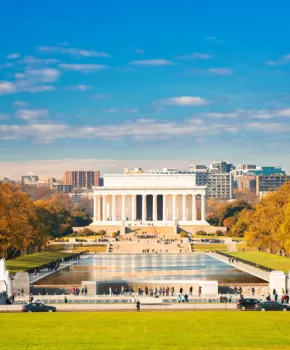
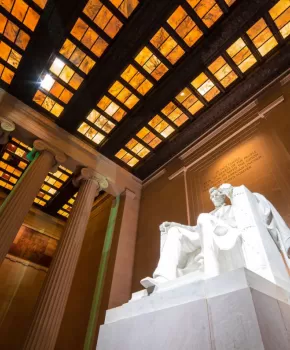
Overview: The Lincoln Memorial stands as one of Washington, DC’s most significant monuments, anchoring the western terminus of the National Mall directly across from the Reflecting Pool. Designed in the neoclassical style of an ancient Greek temple, the structure incorporates 36 exterior Doric columns symbolizing the states united at the time of Abraham Lincoln’s death. Inside, visitors encounter Daniel Chester French’s 19-foot-tall, 175-ton seated marble statue of Lincoln, flanked by carved wall inscriptions of the Gettysburg Address and his Second Inaugural Address. Beyond its Civil War legacy, the memorial serves as a pivotal stage in American civil rights history, famously hosting the 1963 March on Washington where Dr. Martin Luther King, Jr. delivered his “I Have a Dream” speech. Accessible 24/7 with National Park Service rangers on-site daily, it remains an essential, free destination accessible via foot, Metrorail, and Capital Bikeshare.

Photo by washington.org
An insider’s guide to the towering marble tribute, historic speeches, and enduring civil rights legacy on the National Mall.
The Temple on the Potomac
Standing at the western edge of the National Mall, the Lincoln Memorial rises nearly one hundred feet into the Washington sky. Architect Henry Bacon modeled the grand exterior after the Parthenon in Athens. However, this marble sanctuary does not honor an ancient god. Instead, it commemorates Abraham Lincoln, the leader who preserved the Union during its darkest hour.
The building commands attention from miles away. Thirty-six Doric columns surround the exterior walls. Notably, each column represents a state in the Union at the time of Lincoln’s assassination in 1865. Above the colonnade, sculptors carved the names of the forty-eight states that existed when workers dedicated the monument in 1922. As visitors climb the wide stone stairs, the surrounding noise of the capital fades away.
Inside the central chamber sits the famous nineteen-foot statue of Lincoln. Sculptor Daniel Chester French carved the figure from twenty-eight interlocking blocks of white Georgia marble. Lincoln sits draped in thought, gazing past the Reflecting Pool toward the Washington Monument and the Capitol. On the north wall, stonemasons chiseled his Second Inaugural Address. Across the room, his historic Gettysburg Address covers the south wall.
From Healing a Divided Nation to the Civil Rights Frontline
Originally, planners envisioned the memorial strictly as a symbol of post-Civil War reconciliation. At the dedication ceremony in May 1922, keynote speakers emphasized national unity between Northern and Southern white citizens. Meanwhile, event organizers forced Black attendees, including Tuskegee Institute president Robert Russa Moton, to sit in a segregated section across a dirt lane.
Nevertheless, history quickly reclaimed the space.
In 1939, the Daughters of the American Revolution barred Marian Anderson from singing at Constitution Hall because she was Black. In response, First Lady Eleanor Roosevelt resigned from the organization. Interior Secretary Harold Ickes subsequently invited Anderson to perform on the Lincoln Memorial steps on Easter Sunday. Seventy-five thousand people gathered on the National Mall, transforming the memorial into a beacon of civil rights.
Twenty-four years later, on August 28, 1963, more than two hundred and fifty thousand people gathered on those same steps. During the historic March on Washington for Jobs and Freedom, Dr. Martin Luther King Jr. delivered his electrifying “I Have a Dream” speech. Today, an inscription etched directly into the marble landing marks the exact spot where Dr. King stood. As a result, the temple evolved from a quiet tribute into America’s primary stage for democratic progress.
The Ultimate National Mall Stroll: How to Experience It
Exploring the Lincoln Memorial requires smart timing and a thoughtful walking route. Here is how to experience the site like a seasoned traveler.
- Arrive at Twilight or Late Evening
Daytime visits bring school buses, tour groups, and intense midday heat. In contrast, evening visits reveal the monument at its finest. Once dusk settles, warm floodlights illuminate the marble facade, casting dramatic reflections across the pool. Furthermore, walking the steps late at night offers a quiet, contemplative atmosphere that daytime crowds simply obscure. - Pair It with the Neighboring War Memorials
Because the Lincoln Memorial anchors the western end of the Mall, you can easily access several essential sites within a short walk:
- The Vietnam Veterans Memorial: Located just northeast among the trees, Maya Lin’s reflective black granite wall offers an unforgettable tribute.
- The Korean War Veterans Memorial: Sitting just southeast, nineteen stainless steel statues depict a squad on patrol through rugged terrain.
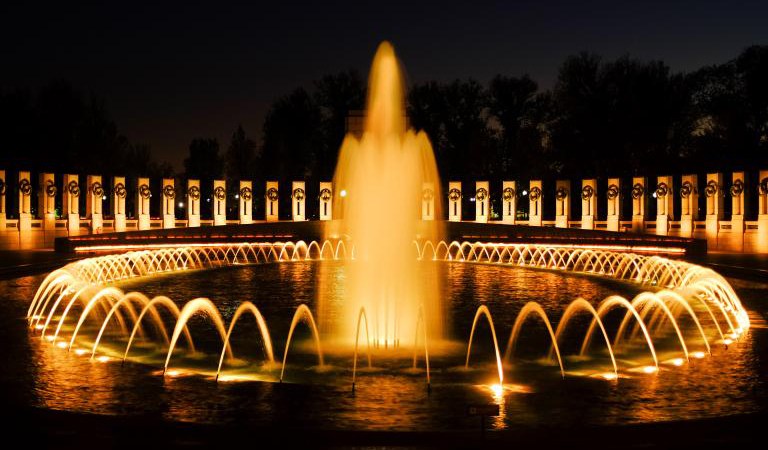
- The World War II Memorial: Walking east along the tree-lined perimeter paths leads straight to the grand fountains and state pillars.
- Practical Logistics
Metro Access: Ride the Blue, Orange, or Silver Line to the Smithsonian or Foggy Bottom station. From either stop, expect a scenic fifteen-minute walk.
Footwear: Wear comfortable walking shoes. The walk from the Washington Monument to Lincoln’s steps spans nearly a mile along gravel and paved paths.
Night Tours: Consider exploring the grounds after dark. When you need a break, sit on the top landing to watch the reflection of the Washington Monument shimmering across the dark water.
Ultimately, the monument stands as much more than an architectural wonder. It remains a living testament to resilience, human dignity, and the unfinished work of building a more perfect union.
Lincoln Memorial hours and directions
The Lincoln Memorial is open 24 hours a day, every day of the year. Rangers are on duty from 9:30 a.m. to 10 p.m. daily. The easiest way to reach the Memorial is by Metrorail or Metrobus. The nearest Metro stations are Foggy Bottom and Smithsonian, both on the Orange, Blue and Silver lines. If traveling by Metrobus, take the 32, 34 or 36 routes. Capital Bikeshare also has a dock nearby, on Daniel French Drive SW.
#LincolnMemorial #WashingtonDC #AmericanHistory