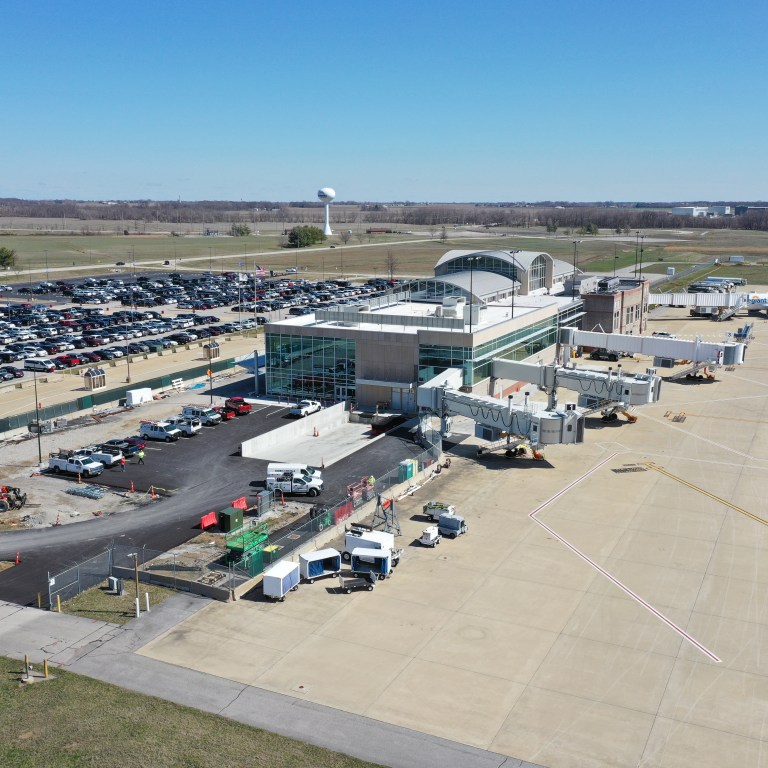

Aerospace growth, emerging aviation technologies put St. Louis’ Metro East at forefront of flight innovation
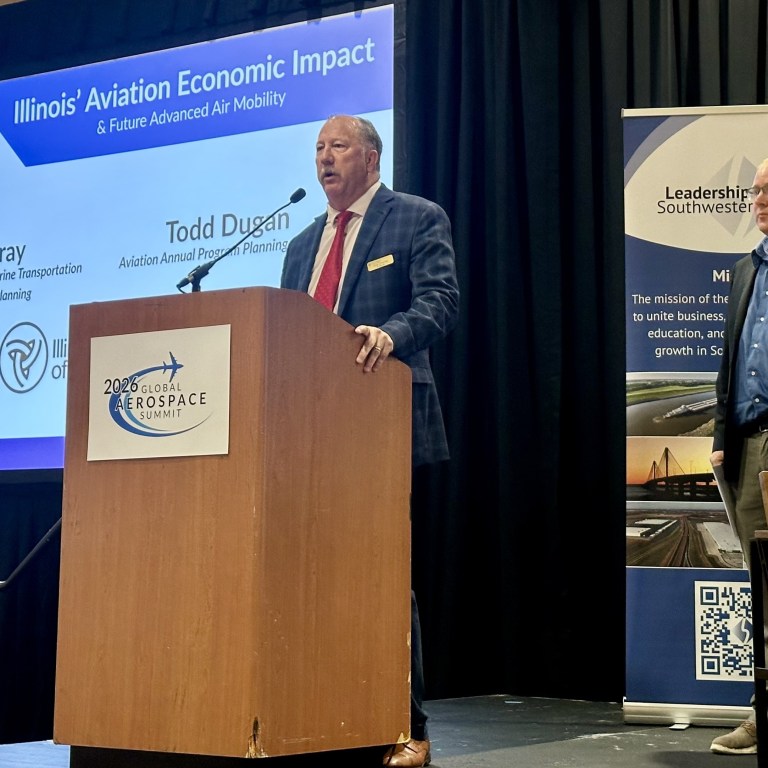
[Edwardsville, Ill. / Aug. XX, 2026] – New aviation technologies ranging from electric air taxis and autonomous aircraft to medical delivery drones and advanced airport planning tools are creating opportunities across Illinois. Those opportunities, and their potential to take off in St. Louis’ Metro East, were highlighted by Illinois Department of Transportation (IDOT) officials during a presentation at the 2026 Global Aerospace Summit held August 19 and 20 in O’Fallon, Illinois.
Presented by BJ Murray, Section Chief of Aviation Transportation Program Planning for IDOT, and Todd Dugan, Aviation Annual Program Planning Specialist for IDOT, the session highlighted statewide studies examining advanced air mobility (AAM), airport operations tracking and aviation’s growing role in supporting economic development, transportation innovation and future infrastructure investment.
Much of the discussion focused on how Illinois is preparing for a new era of aviation that extends well beyond traditional passenger air travel. Through its Advanced Air Mobility System Plan Study, IDOT is evaluating infrastructure, airspace and policy considerations needed to support emerging technologies such as electric vertical takeoff and landing (eVTOL) aircraft, autonomous systems and drone-based operations. The study examines how emerging aviation technologies are beginning to reshape transportation, logistics, healthcare, agriculture and aerospace manufacturing, while highlighting the Metro East region’s role in that evolution.
“We recognized that other states were beginning to lay the groundwork and Illinois was falling behind in planning for this new technology,” Dugan said. “The purpose of the study is to recognize and prioritize existing and near-term advanced air mobility opportunities from an infrastructure, airspace and IDOT policy perspective.”
Panelists noted that advanced air mobility is already moving from concept to reality. Companies across the aviation industry are working toward certification of passenger-carrying electric aircraft, while drone technologies are being deployed for medical deliveries, package distribution and agricultural applications. IDOT’s planning efforts are intended to help ensure Illinois is prepared to accommodate and benefit from those innovations as they expand.
The session highlighted examples already being tested around the world and in Illinois. Medical drone systems have been used to transport blood and critical supplies to remote communities in Rwanda, while Northwestern Medicine in Chicago has explored drone-based transportation of medical samples. Retail and logistics companies continue expanding drone delivery programs, and agricultural operators are evaluating autonomous aircraft capable of supporting around-the-clock field operations.
Presenters also pointed to significant aviation innovation already taking place in the Metro East. Dugan cited Boeing’s MQ-25 Stingray program at MidAmerica St. Louis Airport as an example of next-generation aerospace technology being developed in the region.
“This technology is not just the technology of the future. It is the technology of the present. Look no further than MidAmerica St. Louis Airport and what Boeing is doing with the MQ-25,” Dugan said. “It’s great to see the Metro East leading the charge in some of these new cases.”
As advanced air mobility evolves, presenters said Illinois airports are expected to play an important role in supporting early deployment of new aircraft, while future infrastructure may include specialized vertiports located near urban centers, transit facilities and major destinations. These facilities would require new planning approaches as well as electrical infrastructure capable of supporting aircraft charging systems.
The discussion also highlighted a statewide airport operations counting initiative that uses Automatic Dependent Surveillance-Broadcast (ADS-B) technology to provide more accurate aircraft activity data. The information helps airport planners better understand how runways, taxiways and other facilities are used, supporting airport master plans, environmental reviews and future capital investments.
Murray noted that improved operational data can strengthen planning efforts and help airports secure funding for infrastructure projects by providing a clearer picture of aviation activity and facility utilization.
“This new technology has much more usage and is much more accurate,” Murray said. “It helps to justify capital developments at individual airports and within the system and show how our aviation infrastructure is being used.”
The session also provided context on the scale of Illinois’ aviation system. According to IDOT, the state’s airports generate approximately $95.5 billion in annual economic impact, support nearly 500,000 jobs and connect Illinois to 48 states, 73 countries and five continents. IDOT is currently updating that economic impact analysis – something they do every five years – with new findings expected to be released in spring 2027 after completion of ongoing data collection and analysis efforts.
For the St. Louis Metro East region, MidAmerica St. Louis Airport, St. Louis Downtown Airport and St. Louis Regional Airport collectively generate more than $4 billion annually in economic impact, with significant expansion occurring at each facility since the last statewide study was completed. Presenters noted that upcoming updates are expected to include higher numbers reflecting the continued growth and investment throughout the region’s aviation sector.
The second annual Global Aerospace Summit brought together aerospace manufacturers, suppliers and leaders in military, cargo movement, transportation, economic development and related industries for a two-day program focused on innovation, collaboration and growth. The event was presented by the Leadership Council Southwestern Illinois; Madison County, Illinois; St. Clair County, Illinois, and Bi-State Development’s St. Louis Regional Freightway. To learn more, visit https://leadershipcouncilswil.