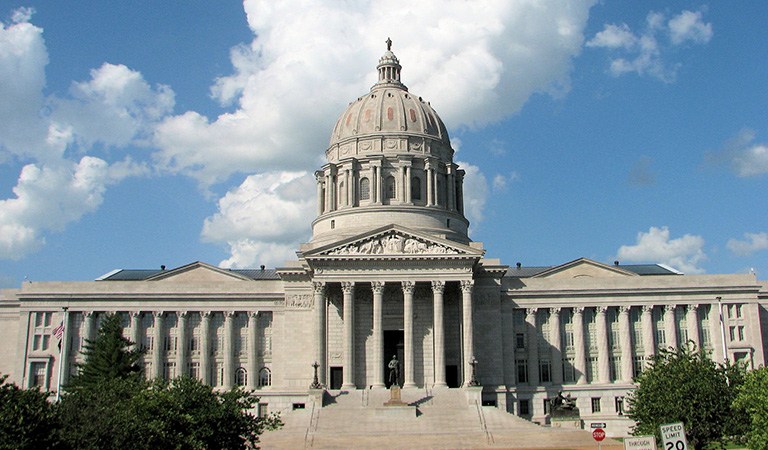

Overview: Missouri is facing a dual political and legal crossroads: the state Supreme Court is weighing whether to strike down 2024’s omnibus public safety law (SB 754) under the state constitution’s “clear-title” rule, while voters evaluate Amendment 7, a proposed constitutional sovereign wealth fund aimed at eliminating state taxes over an estimated 125 to 200 years. Opponents warn that locking general revenue into the Show-Me Prosperity Fund risks worsening present-day budget shortfalls and school funding freezes, while the court challenge could immediately void 29 criminal justice statutes, including Blair’s Law and police oversight restrictions.

How a pending Supreme Court ruling on SB 754 and a multi-century sovereign wealth fund on the ballot could reshape Missouri public finance and criminal law.
Missouri at the Crossroads: Inside the High-Stakes Legal Fight and the 200-Year Tax Gamble
Two massive battles just collided in Jefferson City. One could wipe out a centerpiece criminal justice statute overnight. The other asks voters to stash tax money away into a lockbox for two centuries on a promise that Missouri might someday run tax-free.
Both fights reveal the same underlying truth about state politics: how lawmakers package big promises often matters far more than what the legislation actually delivers.
Here is what is happening right now, why it matters for communities and business leaders across Missouri, and where the fallout lands next.
The Courtroom Showdown Over SB 754: Can Lawmakers Hide 29 Laws Under One Label?
The Missouri Supreme Court heard arguments on October 14 in a case that cuts straight to how laws get made. The lawsuit targets Senate Bill 754, a sweeping public safety package passed in 2024.
When SB 754 started, it was a tiny, single-section bill dealing with police animals. By the time it cleared the General Assembly, it had ballooned into 29 separate provisions covering everything from gun laws to juvenile court rules. Lawmakers slapped the broad label “public safety” on the cover and called it a day.
The Article III Institute sued, arguing the title violates the state constitution’s “clear-title” rule. That rule exists to stop legislators from sneaking controversial measures through the Capitol under feel-good, vague slogans. In a prior 2024 ruling, the Supreme Court specifically warned that phrases like “public safety” are too broad and shapeless to give the public fair warning about what a bill actually does.
The state pushed back, claiming everyone knows what public safety means. Cole County Judge Cotton Walker bought that defense back in March, ruling the broad heading was good enough. Now the high court has the final say.
Why SB 754 Sparked Intense Pushback
The legislation contains measures with passionate supporters and sharp critics:
- Blair’s Law: A decade-long priority for Democrats, naming a ban on reckless celebratory gunfire within cities after Blair Shanahan Lane, an 11-year-old Kansas City girl killed on July 4, 2011.
- Tougher Juvenile Rules: Raising the minimum age for certifying a juvenile to stand trial as an adult from 12 to 14.
- Strict Gun and Fleeing Penalties: Creating an aggravated fleeing offense for high-speed chases and ramping up penalties for illegal gun possession.
- Police Review Board Limits: Stripping local civilian oversight boards of meaningful authority to investigate officer misconduct.
- Police Animal Penalties: Creating severe felony penalties for harming a police animal, without any self-defense exception if a handler orders an unlawful attack. Black lawmakers fought this provision for years, pointing out the historical weaponization of police dogs against Black communities.
By bundling Blair’s Law and other popular items into the final package, bill sponsors managed to break through opposition. If the Supreme Court strikes down the bill on constitutional title grounds, every single one of those 29 measures could vanish in an instant.
Amendment 7: The 200-Year Sovereign Wealth Fund Pitch
While the courts weigh SB 754, voters face a wild question on the November 3 ballot: Should Missouri build a sovereign wealth fund using tax dollars to try to eliminate state taxes 150 to 200 years from now?
The proposal comes from Senate Joint Resolution 95, passed largely along party lines, though eight House Republicans broke away to vote against it alongside Democrats.
If approved, Amendment 7 sets up the Show-Me Prosperity Fund inside the state treasury. Lawmakers would funnel taxpayer dollars into investments. The ultimate goal sounds incredible on a campaign mailer: let compound growth accumulate until the annual earnings cover the entire state budget, allowing Missouri to scrap state taxes entirely.
There is just one glaring catch: nobody voting on this measure, nor their children, nor their grandchildren will likely be alive to see that day arrive.
The Real Problem with the Math
Even vocal backers admit the timeline spans anywhere from 125 to well over 200 years. Some supporters floated an aggressive scenario where the state immediately sinks 250 million dollars into the fund to shorten the timeline to about 125 years.
Critics point out three huge operational flaws in that pitch:
- First, Missouri is already dealing with severe budget crunches. Recent tax cuts cratered state revenue collections, triggering immediate spending freezes and budget cuts to public education. Putting hundreds of millions of dollars into an investment account right now means slashing current schools, roads, and emergency services even deeper.
- Second, other states with sovereign wealth funds do not build them from everyday tax receipts. States like Alaska fund their accounts using oil and mineral royalties, and they use the proceeds to supplement public services like education, not to erase all taxes.
- Third, the constitutional lockbox is airtight. Once tax money goes into the Show-Me Prosperity Fund, lawmakers cannot touch a dime of it until the balance is large enough to wipe out taxes completely. If the state hits a massive economic crisis next decade, that money stays locked away.
Even worse, future legislatures could easily get tired of feeding the fund after a decade or two of tight budgets. That would leave millions of taxpayer dollars trapped in permanent limbo, unable to fix broken bridges today, yet far too small to ever end taxes tomorrow.
The Big Picture for Missouri
Between a fragile 29-part public safety law facing constitutional jeopardy and a ballot measure asking for centuries of blind patience, Missouri voters and taxpayers are staring down monumental choices. The decisions made in Jefferson City this season will echo across courts, municipal budgets, and neighborhood streets for generations to come.

To engage effectively with State Representative Del Taylor (Missouri House District 84), focus on collaborative, actionable community priorities.
- Focus Areas: Ground your outreach in issues affecting District 84 and the wider St. Louis region, particularly neighborhood development, community events, local business support, budget priorities, and constituent resources.
- Collaboration & Events: If you are proposing community events, panel discussions, or local initiatives, frame the request with clear objectives, community benefit, and potential partner organizations to demonstrate strong grassroots alignment.
- Official Legislative Inquiries: For policy discussions, constituent casework, or legislative matters, reach out through his official Capitol office:
- Email: del.taylor@house.mo.gov
- Phone: (573) 751-2198
- Capitol Office: Room 130-DA, 201 W. Capitol Ave., Jefferson City, MO 65101
#MOLeg #ShowMeState #MissouriPolitics