

Diagnoses of the severe, tick-borne allergy are rising throughout the basin. The frontlines of the disease offer lessons.
Elizabeth L. Cline, Arkansas Times
Standing under an eastern hemlock tree near a thicket of lizard’s tail in her backyard — a tick’s dream — Casey Hamaker had flashbacks to the day she first contracted alpha-gal syndrome, a mysterious illness spreading rapidly across the United States.
“This is the scene of the crime,” she said. As she was clearing brush in her garden in the spring of 2024, three ticks — likely lone stars, the aggressive hunters known for causing most cases of alpha-gal — latched onto her. She reached up and found them drawing blood just behind her ear.
Within a few weeks, Hamaker, 49, was consumed by outbreaks of huge, red welts that crept across the tops of her feet, the backs of her knees and enveloped her torso — sometimes dotting her scalp, eyelids and ears. She downed handfuls of allergy medications. She would later find out they contained trace amounts of mammalian products to which she’s now allergic.
“I was really uncomfortable in my own body, and I would just find myself itching like a dog with fleas,” Hamaker said.
Hamaker lives in Fayetteville, a picturesque college town nestled in the Ozark Mountains that’s emerging as an alpha-gal hotspot. Arkansas’ suspected cases have nearly doubled from 1,331 in the first half of 2025 to 2,833 over the same period this year, a significant number in a small, rural state. Northwest Arkansas, with its dense woods and outdoorsy lifestyle, is leading most other regions of the state in positive results.
[mcb-block id=235317]
Arkansas is a bellwether for much of the country, which is just now waking up to this severe allergy that mostly went undetected for decades. According to the Centers for Disease Control and Prevention, as many as 450,000 people have contracted alpha-gal syndrome since 2010 — and given most states began counting cases just in the last few years and the CDC isn’t actively tracking it, that may be a gross underestimate. The condition has been diagnosed in large numbers in tony enclaves like the Hamptons and Martha’s Vineyard, where the tick was barely present 50 years ago.
Alpha-gal syndrome is also rapidly expanding, alongside many other tick-borne illnesses, owing to a perfect storm of climate change, expanding white-tailed deer populations and massive historical shifts in land use and development. The lone star tick — which carries the alpha-gal molecule in its saliva — is on the march, and it’s taking alpha-gal syndrome with it.
As more people test positive, the profound strangeness of alpha-gal syndrome is also moving to the forefront. Once simply referred to as a “red-meat allergy,” the confounding experiences of people like Hamaker — who can be triggered by trace amounts of mammalian ingredients as well as other substances, like seaweed — show that its impacts are more wide-ranging than originally imagined.
We also know that alpha-gal is dangerous. As many as three-quarters of people who test positive experience anaphylactic shock. There have now been a handful of deaths linked to alpha-gal syndrome.
And yet as the condition spreads rapidly and positive tests pile up, scientific understanding is lagging far behind. Researchers are still unraveling the disease, public health agencies are struggling to track it, and there’s little federal funding or coordination driving efforts forward. But that may be changing as awareness — and a little panic — spreads. The challenge now isn’t just understanding the disease; it’s figuring out how to stop it. Arkansas researchers and residents may hold some clues.
An age-old disease?
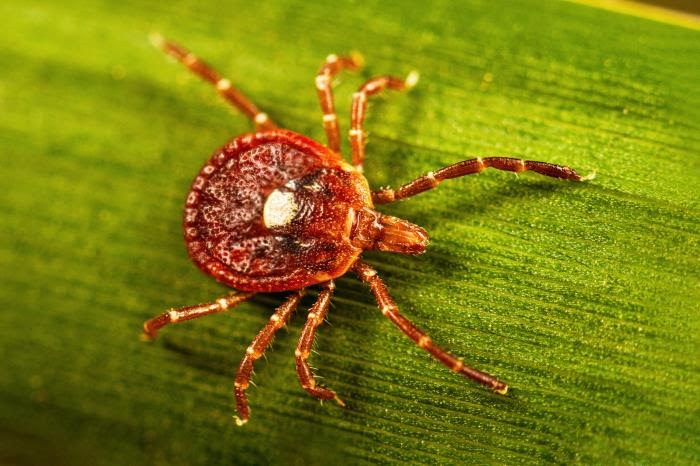
Cresting the verdant foothills of the Ozarks on the drive into Fayetteville, outdoor lovers of the human variety see paradise. Ticks see heaven, too. The lone star tick— so named for the white marking on the adult female’s back — is at home in Arkansas, as it thrives in dense forests and humid climates. Needing animals to feed on — known as blood meals — the creature has once again come to the right place. Arkansas is lousy with wildlife.
While it isn’t the only tick that carries the alpha-gal molecule, the lone star spreads the syndrome more than any other because of its unusually aggressive hunting style. It actively chases after animals — and people — following vibrations and the trail of carbon dioxide.
The syndrome takes its name from a sugar known as alpha-gal. When lone star ticks are born with the sugar molecules in their bodies, and when they bite humans, they pass it into their victims’ blood.
This same molecule is found in the bodies of most mammals, but not humans. For some people, exposure to the molecule causes the immune system to mount defenses whenever they encounter alpha-gal in food or other products (mostly made from mammals), with symptoms ranging in severity from vomiting and hives to anaphylactic shock.
A big question — the one on everyone’s mind — is, how many are destined to get this? It’s thought that only a small percentage of the tick-bitten will go on to develop alpha-gal syndrome, but it’s impossible to say with certainty without more comprehensive studies. In 2013, researchers estimated that less than 10% of those with alpha-gal antibodies (known as sensitization) go on to develop the allergy, but University of North Carolina School of Medicine researcher Scott Commins is convinced the number is far lower. Recent research he contributed to may underscore his theory: 31% of a sample population from Arkansas tested positive for alpha-gal antibodies, a far larger portion than have gotten sick.
“I think the tick-bitten number is incredibly large, so the percentage of people who go on to develop the allergy in that scenario, in my mind, is really small,” Commins said. Martha’s Vineyard, he said, would be a good place to run a more controlled trial to finally solve the riddle.
Some Arkansans have tales of a distant cousin or a granddad suffering from a mysterious red meat allergy — decades ago. Alpha-gal syndrome has likely been lurking in the Ozarks for generations, but few would deny that something is making it far worse. That something, new research shows, is climate change.
According to Dalton Williams, a researcher at the University of Arkansas who studies the relationship between tick-borne illnesses and ecological shifts, ticks are far more active year-round in Arkansas than they were just 15 years ago. While residents once could depend on a reprieve in cooler months, when lone stars would freeze to death or go into hibernation, warmer winters mean tick season stretches on much longer. “Now we’re seeing a lot of cases through the fall and steadily going through the winter,” Williams said.
Using satellite climate data and thousands of tick samples, Williams produced research in May showing that the increasing humidity in June and July — peak tick season in Arkansas — is pushing ticks into more pockets of the state, as ticks depend on humidity to survive. Their hosts also seek out moist plants for food. “Not only are ticks endemic across essentially the whole state, but they are also more inclined to feed and breed,” he said.
Climate change is also extending tick season across the country — and pushing the lone star into the upper reaches of the Midwest and New England.
According to Dalton Williams, a researcher at the University of Arkansas who studies the relationship between tick-borne illnesses and ecological shifts, ticks are far more active year-round in Arkansas than they were just 15 years ago. While residents once could depend on a reprieve in cooler months, when lone stars would freeze to death or go into hibernation, warmer winters mean tick season stretches on much longer. “Now we’re seeing a lot of cases through the fall and steadily going through the winter,” Williams said.
Using satellite climate data and thousands of tick samples, Williams produced research in May showing that the increasing humidity in June and July — peak tick season in Arkansas — is pushing ticks into more pockets of the state, as ticks depend on humidity to survive. Their hosts also seek out moist plants for food. “Not only are ticks endemic across essentially the whole state, but they are also more inclined to feed and breed,” he said.
Climate change is also extending tick season across the country — and pushing the lone star into the upper reaches of the Midwest and New England.
White-tailed deer, hunted nearly to extinction across much of the U.S., including in Arkansas, have made an extraordinary comeback in the past century. In the 1920s, Arkansas began to develop its economy around big game hunting. Today, there are an estimated 1 million white-tailed deer in the state, up from about 1,000 in 1947, something the Arkansas Game and Fish Commission touts with great pride. Across the country, there are 30 million white-tailed deer.
Williams, the University of Arkansas researcher, said that deer and other host animals like raccoons and squirrels are common within Fayetteville’s city limits. “Some people think it’s really wholesome, but every time I point at them, I say they’re dropping off ticks.”
Ticks don’t wander far from their hosts, and thus it takes the combination of hosts, humans and ticks to produce a tick bite that leads to alpha-gal. That’s more likely to happen where humans are pushing into nature. While Arkansas is well-known for its pristine natural landscapes, Northwest Arkansas is rapidly developing, with hundreds of miles of mountain bike trails recently cut into the Ozarks; that, too, could be playing a role. A 2025 study of those living with alpha-gal in Virginia and the Carolinas found that cases were associated with areas where homes and lawns border wooded land or break up woods, indicating that urbanization and development into forests might be linked to contracting the disease.
In 2023, Arkansas became the first state to make alpha-gal syndrome a reportable disease, with doctors and labs required to turn over positive results to the state Department of Health. Once the agency receives a positive test result, the department independently verifies it to separate out the people who are simply positive for alpha-gal antibodies versus those who are symptomatic.
But the agency has not moved beyond information collection and some modest public education. When asked if the health department operates, funds or coordinates any tick-control programs or has plans to, public health veterinarian Dr. Laura Rothfeldt said, “There are no resources or staff specifically designated for mosquito and tick control.”
Not just a red-meat allergy
As Hamaker suffered with all-consuming bouts of hives, it never occurred to her that it was alpha-gal syndrome. She has friends who had the condition — they would throw up from eating pork, for example, but none of them had hives. “Never in a million years would I have thought that it was alpha-gal,” she said. Her doctors missed it, too. She saw five different doctors over nearly a year and a half before finally being diagnosed.
Alpha-gal syndrome was first recognized by the American scientific community in 2009, and thought then to be strictly a red-meat allergy largely confined to the Southeast. That it took until then to be identified in the American scientific literature is a testament to its strangeness. Since then, the symptoms have only proven to be even weirder and far-reaching.
Unlike other food allergies, which prompt an immediate reaction, most alpha-gal victims’ first reaction occurs about one to two months after a tick bite and about four to six hours after eating a mammal or other allergen, often striking in the middle of the night. “You have to think back, like, what was I doing? Where was I? What did I eat?” Hamaker said.
Because it’s delayed, alpha-gal syndrome is often confused for food poisoning or, in Hamaker’s case, anxiety. “Every doctor I went to was like, ‘Oh, it’s just stress,’ and that was very frustrating,” she said.
Covered in hives and nearly driven mad from sleepless nights, Hamaker finally landed in the offices of Dr. Tina Merritt, a leading authority on alpha-gal syndrome, with a bustling practice in nearby Bentonville. Hamaker is one of Merritt’s 1,200 alpha-gal patients, up from zero two decades ago, including those who see her via telemedicine from as far away as New York and Florida.
Merritt is a legend in the alpha-gal world. She helped identify the condition two decades ago — and has lived with it herself ever since she was bitten by about “a hundred seed ticks,” tiny newly hatched ticks smaller than a grain of sand, at a summer camp in north Louisiana when she was in third grade. “I think because I’ve had the allergy, I understand that the symptoms can vary and they vary all the time,” she said.
Merritt is currently studying more bizarre manifestations of alpha-gal syndrome. One patient’s voice gets hoarse at the mere smell of pork; another patient gets brain fog. Some have severe cardiovascular events similar to heart attacks. In August, she co-published a national survey of 3,000 alpha-gal patients showing that it affects many systems of the body, including the skin, brain and heart. More than 70% of those surveyed reported experiencing hives.
Merritt’s poison is gelatin, typically made from the bones and skins of pigs and cows and found in foods, cosmetics and pill capsules. If she accidentally ingests it, she can get dizzy and lose consciousness. The last time it happened, about eight years ago, Merritt was boating with friends on Beaver Lake in the Ozarks. After taking a Jell-O shot, she started to feel queasy and fainted on the floor of her boat. She came to hours later, to her friends asking, “Is Tina dead?” The national survey indicates she’s not alone — 16% of respondents reported losing consciousness from alpha-gal exposure.
As for what protects some from the syndrome, there aren’t great answers there either, Merritt said. It could have something to do with genetics or having type-B blood. Other conditions, such as an autoimmune disease or a vitamin D deficiency, are thought to make it worse.
Not every allergist thinks alpha-gal is responsible for such a plethora of maladies. Joshua Kennedy, an immunology and allergy researcher and doctor at the University of Arkansas for Medical Sciences in Little Rock, believes alpha-gal syndrome is being misdiagnosed in some cases because a positive test only indicates sensitization — not that certain foods or products are causing a patient’s allergies. His goal, he said, “is to be more aggressive in how we get foods back into people’s diets, if necessary.” Kennedy does that through highly controlled food challenges, where patients consume what they’re allergic to in a supervised setting.
Determining who’s right will take more research — and lots of it. Commins, the researcher at the UNC School of Medicine, said that alpha-gal research has too little federal attention. “The funding of this is really limited, and there seems to be a big disconnect,” he said. As of now, much of the literature that exists on alpha-gal syndrome is based on patients who come through specialists’ doors.
Detective work
Hamaker’s home is transformed in subtle ways. Her bathroom drawers, once full of makeup and face creams and the trappings of female-dom, are spartan. All that remains are a stick of Tom’s deodorant, a single tube of mascara by e.l.f. (the only brand she’s found that doesn’t cause her eyelids to erupt in hives) and alpha-gal-friendly allergy medication. Her toothpaste, shampoo and lotion are all absent of any mammalian ingredients. Her refrigerator and pantry are stocked with simple ingredients, like rice, produce and chicken, a meat she can safely eat.
Hamaker’s diagnosis was just the beginning of months of detective work, as she toiled to understand each flare-up. She discovered a mind-boggling number of ingredients contain trace amounts of the alpha-gal molecule, including the lubricating strip of her shaving razors (some are made with lanolin from sheep), dry-roasted peanuts (some of which contain gelatin) and even some brands of bottled water (which is filtered using bone char sourced from mammals).
Navigating alpha-gal is challenging considering how many products have trace bits of mammalian products in them — and poor labeling. The CDC does not maintain a comprehensive list of products that may contain alpha-gal molecules, nor does the Food and Drug Administration recognize alpha-gal as a major food allergen, although some advocates are trying to change that.
Hamaker, who works as an accountant for a charitable foundation, now fears client dinners and work conferences. “I am terrified of buffets. I don’t eat catering. I don’t eat at luncheons,” she said. If a restaurant promises her the food is alpha-gal friendly, she often doesn’t risk it: A small amount of cross-contamination on the grill could send her body into a full-blown reaction.
Even well-intentioned hangouts can spell trouble. A friend invited her over, promising an alpha-gal-friendly meal. Hamaker broke out into hives a few hours later. She later pieced together why: “I learned about my friends’ dogs that ate red meat. I couldn’t pet them because I was allergic to their dander and saliva,” she said.
Another hidden danger for alpha-gal syndrome sufferers is medications that contain the sugar molecule. Acetaminophen, supplements like vitamin D, some vaccines and even medical devices like heart valves and sutures can have animal ingredients and can be administered to patients without their knowledge.
Researchers are puzzling through more sensitive cases like Hamaker’s. But Merritt’s survey seems to indicate that many of Hamaker’s own seemingly odd reactions are quite common: 40% reported reactions to mammalian ingredients in personal-care products and prescription drugs; about 67% of people report an allergy to dairy. And her earlier research showed that 10% are allergic to carrageenan in red seaweed, which also contains the alpha-gal molecule.
Hamaker’s allergy to carrageenan ruined rotisserie chicken for her when she found out some — but not all — store brands use it to keep the meat moist. “I just like almost started crying because on the ingredients it said carrageenan, and I was like, ‘You’ve got to be kidding me!’” Hamaker said.
For now, people with the syndrome lean heavily on third-party apps like Fig, which has a barcode scanner that will flash X if a food isn’t safe, and Pill Clarity, which started out catering to vegans but is now relied on by alpha-gal patients to find pills and medical devices that don’t contain allergens. It also helps to live in an alpha-gal hotspot like Fayetteville, where there are numerous support groups, a few alpha-gal-friendly restaurants and other alpha-gal-afflicted people to commiserate with.
Hamaker’s boyfriend, Matt West, eats alpha-gal-friendly meals, at least at home, and has supported her in making changes to her lifestyle (although he still sneaks off on occasion to down a hamburger on his own). As more people get alpha-gal syndrome in the area, Hamaker and her family are finding themselves in good company.
“In the last year, it went from, ‘You have what?’ to, ‘Oh, my cousin has that or my daughter-in-law has that,’” West said. “And just the way that it kind of shows itself, too. There are so many variations of it.”
All-out war on ticks?
There may be another effective treatment for managing severe alpha-gal symptoms, called Xolair, an injection approved in 2024 by the FDA for food allergies. While it won’t let alpha-gal victims feast on hamburgers again, for some it seems to cool their reactions from accidental exposure.
Some members of Congress have advocated more research, while other lawmakers have proposed classifying alpha-gal as a major food allergen for labeling purposes. Robert F. Kennedy Jr. announced in May a multimillion-dollar pilot program between the CDC and the Department of Health and Human Services to, among other things, evaluate new drugs that could prevent people from developing alpha-gal syndrome following a tick bite.
But an all-out war on ticks is where the mind goes when contemplating a blood-sucking parasite that can potentially kill people — or steal away their favorite foods. “I hear people say all the time, ‘Why don’t we just kill all the ticks?’” said Williams, the University of Arkansas researcher.
Calls for authorities to do something drastic are growing. The syndrome is spreading on the heels of other tick-borne illnesses like Lyme disease, which is severe in some parts of the Northeast. Martha’s Vineyard is considering a proposal to cull 70% of the white-tail population.
But going after the deer could be a nonstarter in many wildlife-loving places like Arkansas. Catherine Love, a wildlife veterinarian for the Game and Fish Commission, put it bluntly: “You couldn’t cull them at a rate in Arkansas without pissing off every hunter,” she said. Love is convinced the ticks would simply relocate to other hosts and warns it could be our pets instead.
RFK Jr.’s May announcement also included commitments to develop new products to eliminate ticks on wildlife. Some have suggested simply treating deer with insecticides, either on their coats or via bait. It could work but makes ecologists like Williams nervous. “I’m always kind of iffy on putting ecosystems in flux,” he said.
Going to war on ticks would be harder than fighting mosquitoes — a biting insect whose disease-spreading habits we’ve largely wrangled. While mosquitoes breed in standing water, making killing off larvae easy, ticks drop their eggs anywhere they topple off a host, said Emily McDermott, a vector ecologist at the University of Arkansas who researches how ticks spread pathogens and move through their environment. “You can’t just walk around the woods and say this is where the larvae are — here and not there,” she said.
Culling the ticks will require many different strategies rolled out in conjunction, McDermott said, from better land management techniques like keeping tall grasses cut back and brush cleared, to novel treatments like insecticides applied to deer.
To push alpha-gal out of the realm of personal problem into public responsibility will require coordination — across wildlife management, medical professionals and local and federal governments — at a time when trust is low. It will inevitably involve bumping up against contentious issues like vaccines, pesticides and government intervention. While federal help is needed, local solutions are wise, McDermott said.
The good news is ticks aren’t everywhere, all the time. Lone star ticks, for example, prefer edge habitats between forests and grasslands or the borders between a suburban lawn and woods.
It might also help humans to understand the creatures hunting them. Ticks are not on an endless quest for blood. They eat just a few times in their lives. After they feast, engorged nearly until the point of popping, ticks lie nearly motionless, digesting for months. If the weather gets too dry or hot, lone stars dry out and dessicate — transforming into tick mummies. “They’re not just vindictive, evil creatures bent on destruction. They’re animals doing animal things,” McDermott said. She also noted that basic tick protection, like wearing permethrin-treated clothes and doing thorough tick checks after an outdoor escapade, is quite effective.
The good news is that for some people, alpha-gal goes into remission eventually, typically within three to five years, as long as patients avoid red meat and other substances they are allergic to and, most importantly, avoid getting other tick bites.
Nowadays, Hamaker still experiences small outbreaks on her ears and eyelids, but gone are the sleepless nights and scratching until her skin bleeds. She has no regrets about learning how to cook unprocessed foods using whole ingredients. “So much of these things, like red meat and cheese, are inflammatory anyway toward your joints, so maybe it’s not a bad thing,” she said.
The one thing Hamaker refuses to do is move. Her home is nestled into two and a half acres planted in huge magnolias, eastern hemlocks and leafy garden beds. She has no plans to give up mountain biking, hiking or hanging out in the yard with her partner and her three dogs.
“I pulled a tick off of me last Friday,” she said. “It’s like, I don’t know how I can avoid it. Move into an apartment in the city?” Alpha-gal syndrome has made its way to bigger cities, anyway. Nowhere is safe.
This story is a product of the Mississippi River Basin Ag & Water Desk, an independent reporting network based at the University of Missouri in partnership with Report for America, with major funding from the Walton Family Foundation. Used by The Narrative Matters with permission,
| How to keep the creepy crawlies at bay – SIDEBAR In a region where outdoors is a way of life, there’s no need to cede territory or fun to ticks. Basic precautions can go a long way to avoiding alpha-gal. Here’s what you need to know: Practice basic precautions. Wear long socks tucked into pants; avoid rubbing up against tall grass and brush. Stay on trails. Consider wearing permethrin-treated clothing and tick repellents labeled for skin application. And stay on guard, as ticks are now more active year-round due to climate change. Conduct a thorough tick check. Check for ticks on clothes and skin while outside. Once inside, remove clothes and closely check armpits, genitals and scalp. Dry clothes on high heat to kill undetected ticks and take a shower to help detect ticks and wash them off of skin. Remove ticks quickly and carefully. Try to pluck off ticks before they bite. If attached, remove quickly to decrease changes of getting a tick-borne illness. Using tweezers, pull carefully near the head. Once removed, clean the bite area. Evaluate your landscaping. Eliminate piles of leaves and brush. Consider avoiding plants that attract deer and other host animals, like raccoons and rabbits. Do not feed wildlife, as this can lead to hosts lingering and dropping ticks. Consider precautions for pets. Tick-control medication is shown to reduce tick bites in their human owners. Get tested if you have symptoms. Alpha-gal syndrome is diagnosed by a blood test and can only be confirmed when symptoms are present. There’s currently no cure for alpha-gal, but it is manageable with proper medical care and, for some, goes away within three to five years. |