


Articulated Insight – “News, Race and Culture in the Information Age”
Overview: Real small business growth requires operational discipline, back-office tax compliance, and long-term ecosystem support rather than short-term social media accelerators. On The Inclusive Voice Podcast, host Pam McElvane sat down with Chinese Mutual Aid Association leaders Ducky Javra and Ian Quan to explain how underrepresented founders navigate the four-stage business cycle, access institutional capital, and secure lucrative government contracts through strategic teaming and persistent capability development.
Why quick-fix boot camps fail underrepresented founders and how true community anchors turn local shops into institutional contractors
From Food Stalls to Federal Contracts: The Brutal Truth About Scaling Beyond Social Media Hype
If you scroll through business social media long enough, someone in a rented suit will promise you that a four-week boot camp can turn an idea into an overnight windfall. They tell you to register an LLC on Monday, call yourself a corporation on Wednesday, and start billing Uncle Sam by Friday.
Ask anyone who actually signs the checks or delivers the work, and they will tell you the truth: that is a complete bill of goods.
On a recent episode of The Inclusive Voice Podcast, host Pam McElvane sat down with two leaders who live in the trenches of real community wealth creation: Ducky Javra, Director of the Economic Development Center at the Chinese Mutual Aid Association (CMAA), and Ian Quan, Director of the APEX Accelerator Program.
Their message for small business owners across Illinois and beyond was clear, practical, and delightfully blunt. Sustainable growth does not come from glossy shortcuts. It comes from solid foundations, operational discipline, and deep community anchors.
The Myth of Fast-Track Acceleration
Everyone loves using the word “accelerator.” But as Ian pointed out, true acceleration into institutional contracting is a marathon, not a sprint.
Government contracting is a massive, multi-billion-dollar playing field, but it is also one of the strictest buyers on earth. Breaking into that arena often demands a realistic three to four-year ramp-up. You do not just show up with an elevator pitch; you need past performance, clean books, compliance systems, and customized capability statements. When programs promise to make a founder procurement-ready in twenty-one days, they skip the fundamentals that keep companies alive.
Ducky echoed that reality from the small business advising front. If a business owner does not understand their actual corporate entity, cash flow, and tax obligations, jumping straight to bidding is like pouring water into a cracked bucket. CMAA watches too many entrepreneurs walk in with advice they picked up from social media, believing tax elections are legal structures or assuming revenue appears automatically once an LLC is stamped.
Real development works through four distinct phases: formation, capitalization, operational growth, and market access. Skip a step, and the entire structure falls apart when stress arrives.
📢 Community Impact Spotlight: Shape the Future of Chicago Resources
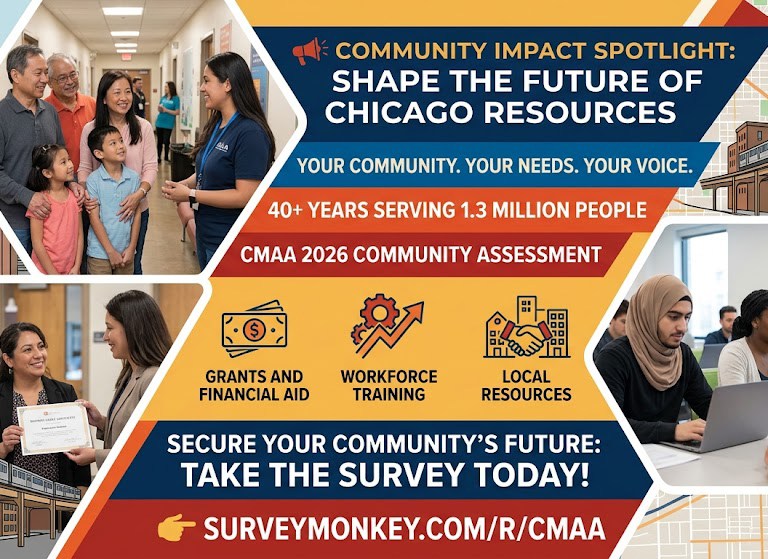
Are you tired of business programs and neighborhood initiatives that don’t quite fit your day-to-day realities? For over 40 years, the Chinese Mutual Aid Association (CMAA) has been a cornerstone for Chicago-area families and entrepreneurs, serving over 1.3 million people across Uptown, West Ridge, and Elgin. Now, heading into the second half of 2026, CMAA is launching a brief community assessment to find out exactly what kind of financial assistance, workforce training, and local grants your neighborhood needs most right now.
Don’t leave community resources on the table. By taking just five minutes to complete this survey, your feedback will directly guide future funding and ensure local support goes precisely where it will help your bottom line. Secure your community’s future and make your voice count today at surveymonkey.com/r/CMAA.
Anchors Over Algorithms
Why does CMAA succeed where generic business programs stall? Because they operate as a community anchor.
Headquartered in Chicago’s vibrant Uptown neighborhood on Argyle Street, CMAA has delivered direct, wraparound social services for forty-five years. Seven years ago, they expanded that support directly into business equity, recognizing a simple human truth: stability at home creates stability in business.
Walking into their offices feels like walking into the United Nations. With staff speaking more than forty languages, they meet immigrant, refugee, veteran, and minority entrepreneurs where they are. That cultural fluency builds immediate trust, but trust is only the entry point. Access to capital, technical training, and institutional relationships must follow.
As Ducky explained, when a business takes root in a neighborhood, spends money with neighborhood suppliers, and hires local talent, it creates a closed loop of wealth. Those business owners become stronger community advocates and long-term economic stabilizers.
The Hard Truths of Growth
Both leaders shared concrete, unvarnished advice for founders ready to stop dreaming and start scaling:
- First, fix your back office before pitching buyers. Ian recounted working with a founder who wrote a flawless technical proposal, offered the sharpest pricing, and won the evaluation on paper. Yet she was disqualified immediately. Why? She had not filed or paid taxes in three years. If you are not tax-ready and banking-ready, you are never government-ready.
- Second, get out of your own head and delegate. Micro-entrepreneurs frequently run entire operations out of their personal memory. When every operational detail lives in your brain, you do not own a company; you own a high-stress job. Putting workflows onto paper is the only way to delegate tasks, free up your time, and focus on strategic business development.
- Third, turn rivals into consortium partners. The federal government often prefers contractors with scale. Small businesses competing against industry giants will lose if they bid alone. But when three or four local shops join forces as a joint venture, like local construction firms did on the Obama Presidential Center project, they become formidable competitors that large buyers take seriously.
- Fourth, commit to the reps. Meeting once a week with certified advisors, registering properly on platforms like SAM.gov, and walking through procurement checklists yields tangible results. Ducky shared how one dedicated client opened an Ethiopian beauty spa within three months of hands-on advising, while another secured $120,000 in capital through targeted investor preparation. The speed of growth matches the founder’s willingness to do the disciplined homework.
The Power of Iron Sharpening Iron
No single advisor or program holds every answer. That is why CMAA deliberately partners across the ecosystem with groups like the Women’s Business Development Center, regional chambers of commerce, and local financial institutions. Their calendar stays packed with hands-on labs where founders pitch face-to-face to real agency buyers and learn how to navigate procurement matchmaking before spending a dime on travel.
Your net worth truly mirrors your network. For entrepreneurs ready to build lasting generational assets, the path forward starts by ditching internet hype and plugging into real partners who tell you the truth, keep you compliant, and walk the entire road beside you.
Immediate Next Steps for Entrepreneurs and Stakeholders
- Audit Core Registrations: If public or corporate contracting is on your roadmap, verify your active status on SAM.gov and ensure all state, local, and federal tax filings are fully reconciled.
- Connect with CMAA Business Advising: Visit chinesemutualaid.org, head to the Economic Development Center tab, and book an intake session with an advisor to map your growth cycle from formation to market access.
- Join Upcoming Procurement Sessions: Subscribe to the CMAA newsletter to track upcoming buyer briefings, pitch sessions, and matchmaking workshops designed to connect your capability statement directly with procurement officers.
#GovernmentContracting #SmallBusinessGrowth #InclusiveEconomy