
Leaders from Boeing, Gulfstream Aerospace, and West Star Aviation have announced significant investments in facilities, technology, and workforce development, solidifying St. Louis’s position as a key hub for aerospace manufacturing and aircraft maintenance.
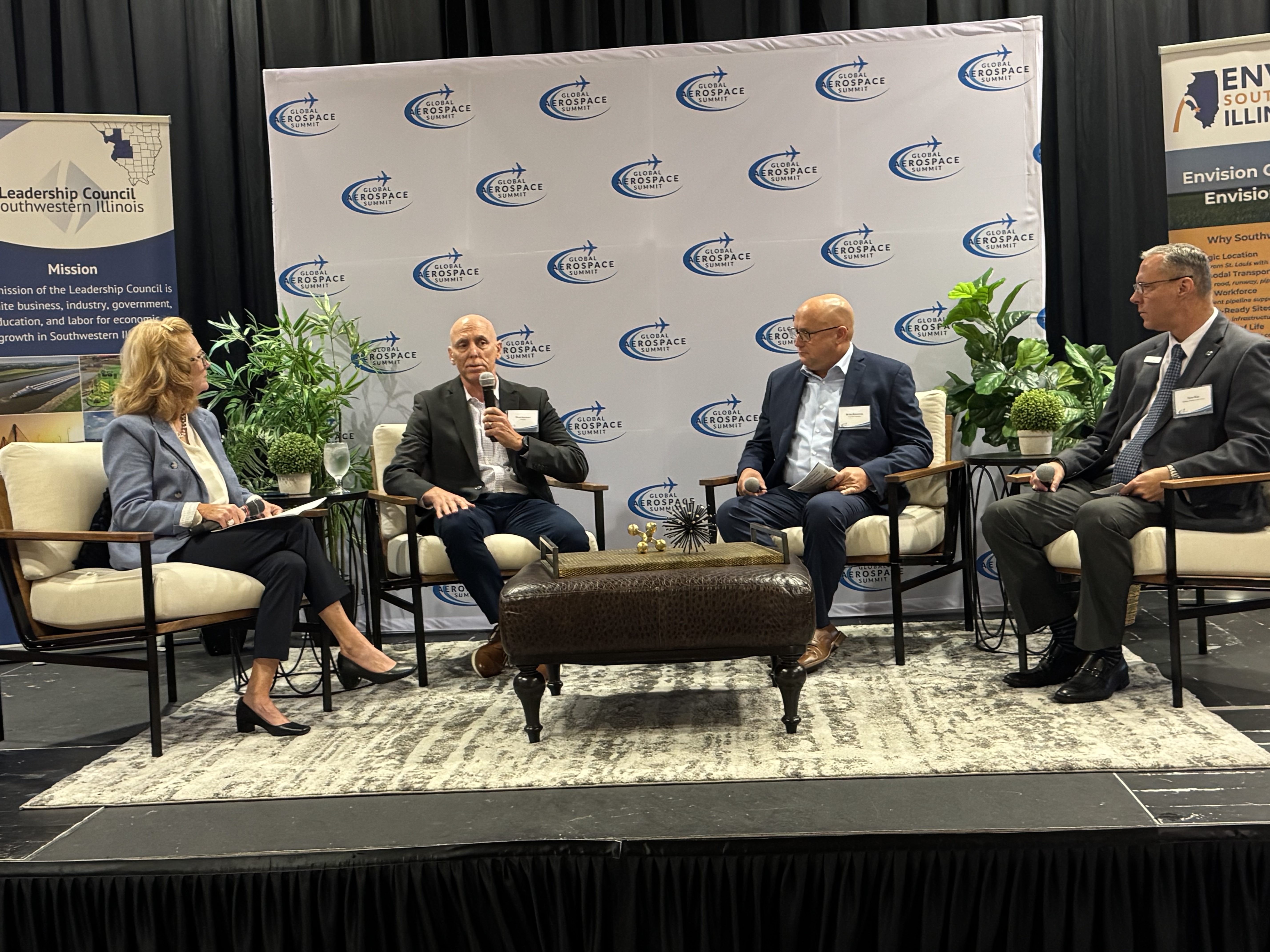
[O’Fallon, IL / Sept. 1, 2026] – Leaders from Boeing, Gulfstream Aerospace Corp., and West Star Aviation recently highlighted significant investments in facilities, technology and workforce development initiatives that are expanding the St. Louis region’s role as a major center for aerospace manufacturing and aircraft maintenance. The discussion, titled “Building and Sustaining the Fleet: OEM, MRO and Defense Perspectives,” was part of the 2026 Global Aerospace Summit August 19 and 20 in O’Fallon, Ill., that showcased the region’s aerospace momentum.
[mcb-block id=235317]
The panel featured Chad Nicklaus, Director of St. Louis Site Integration and manufacturing leader for Boeing’s St. Louis operations; Tony Ray, Vice President and General Manager St. Louis Completions for Gulfstream Aerospace Corp; and Brian Bauwens, Director of Bombardier Business Development for West Star Aviation. The discussion was moderated by Mary Lamie, Executive Vice President of Multimodal Enterprises for Bi-State Development and head of its St. Louis Regional Freightway enterprise. The panelists offered perspectives spanning military aircraft production, business-aircraft completions and support, and maintenance, repair and overhaul, commonly known as MRO. Their comments illustrated the breadth of the bi-state St. Louis region’s aerospace sector that designs and manufactures new aircraft, equips and delivers business jets, and maintains aircraft throughout their operational lives.
Boeing Expands Capacity for Defense Programs
Nicklaus said Boeing’s St. Louis operations are today known as Boeing Fighter Land USA, bringing together manufacturing, engineering, supply chain, and supplier teams to design and build aerospace defense projects for domestic and international customers. Boeing has 18,000 employees and about $2 billion of active payroll in the region. Products and capabilities discussed during the session included the F-15EX, F/A-18 Super Hornet, T-7A Red Hawk, MQ-25 Stingray and ground-based flight-test simulators and weapon systems.
Demand for the F-15EX is prompting Boeing to invest $1.8 billion to expand its operations by St. Louis Lambert International Airport and increase its production rate, he said.
“We’re answering that call by actually investing in our capacity, hiring and expanding our operations, going from one aircraft a month to two aircraft a month,” Nicklaus said. “That’s 12 to 24. We want to be ready to answer the customers’ needs, stand up operations, ramp up, and be ready to go when things hit.”
He said Boeing also has invested $200 million in the new MQ-25 production facility at MidAmerica St. Louis Airport in Mascoutah, Ill., and is making broader investments in buildings, tools and the workforce needed to support future programs. “There’s a great future for the MQ-25 in that facility,” Nicklaus said. “We’re super excited to get that product to the fleet as soon as possible.”
Nicklaus said the investment and activity surrounding Boeing’s programs point to additional opportunities throughout the regional aerospace economy. He also touched on Boeing’s corporate citizenship, noting that the company spent $1.6 million in 2025 across numerous non-profit organizations and that employees volunteered 12,000 hours in the community, with a heavy focus on STEM education.
Gulfstream Builds on Rapid Growth at St. Louis Downtown Airport
Ray described Gulfstream’s continued growth at St. Louis Downtown Airport, where the company had an established an MRO operation before adding aircraft-completions and outfitting capabilities. Its completions work includes interior installations, paint, avionics, cabinetry, carpeting and flight testing.
The expanded operation represented an investment of more than $30 million and added over 200 new jobs, according to Ray. Gulfstream delivered its first locally completed aircraft in 2023 and Ray said they expect another successful delivery year in 2026.
Gulfstream continues to invest in advanced manufacturing, flight-deck and cabin technologies, as well as the services required to support aircraft after they enter service. Ray also highlighted the company’s work involving sustainable aviation fuel (SAF) and testing intended to reduce contrail-forming emissions.
“Gulfstream was the first OEM [Original Equipment Manufacturer] to fly across the Atlantic Ocean utilizing SAF, which we’re very proud of, and we followed that up with being the first OEM company to also fly with both engines on 100% SAF,” Ray said. “Sustainability continues to remain a pillar for us moving forward. We’re excited about what that means for us as an organization.”
He described St. Louis as an important part of Gulfstream’s global business, serving customers from North America, Asia, Europe, and the Middle East, among other markets.
“It’s a booming aviation hub, with a very skilled workforce, and we’re continuing to partner with and invest in this community,” Ray said.
West Star Aviation Invests in Facilities, Technology and Talent
Bauwens discussed West Star Aviation’s growing MRO presence at St. Louis Regional Airport in East Alton, Ill., where the company operates more than 600,000 square feet of facilities and now employs just over 700 people. West Star also operates a hangar at St. Louis Downtown Airport.
The company has expanded its infrastructure, added hangar capacity and invested in new scheduling and planning capabilities to manage the large number of aircraft moving through its operations. Bauwens said they currently have 117 aircraft on site and expect to deliver 40 – 43 of them by the end of August.
“For us, that’s huge innovation,” Bauwens said of the company’s new scheduling and planning systems.
He added that they also are looking at acquisitions as the company works to expand its engineering and repair capabilities to complete specialized modifications and keep more work in-house.
West Star is also pursuing additional foreign aviation authority certifications that would enable more internationally registered aircraft to receive service in the region. Bauwens said the effort can attract customers from outside the United States and generate additional business for regional suppliers and service providers.
“We’re trying to bring more money into the region,” Bauwens said. “We currently have 11 outside or foreign authority certifications where we can work on those airplanes from outside of our states or outside the U.S.”
Workforce Development Emerges as a Shared Priority
Despite representing different segments of the aerospace industry, all three panelists identified workforce availability as one of the most important factors influencing future growth.
Boeing recently marked the first anniversary of a mechanic apprenticeship program that combines classroom education with hands-on instruction using Boeing plans, drawings, and production tools. Nicklaus said 230 graduates had moved into regular production positions. Boeing’s longstanding partnership with St. Louis Community College has also produced a pathway for hiring approximately 1,300 production employees since 2007.
“Capturing skilled and capable people is so important to everything we all do,” Nicklaus said. “It’s really been a great pathway into the Boeing company and then onto better things, not only for Boeing, but for individuals’ careers.”
Gulfstream is working with schools, community colleges, universities, military programs and career and technical education partners to expose students and transitioning service members to aviation careers. Its partnerships include the Belleville, Ill.-based Center for Academic and Vocational Excellence, commonly known as the CAVE, and programs with Southwestern Illinois College, Lewis and Clark Community College and area school districts.
“This is an exciting time,” Ray said. “The types of careers and jobs available within our industry can be life-changing.”
West Star Aviation has developed the West Star Aviation Academy in partnership with Southwestern Illinois College. Bauwens said the program recently graduated its fourth class and has achieved an approximately 85% retention rate among its participants. Graduates enter the workforce with aviation credentials and opportunities to pursue additional certification and career advancement.
“The growing need for individuals in this is just so massive,” Bauwens said. “Come visit the sites, because that’s how we get people interested in this business.”
Collaboration Strengthens the Regional Aerospace Ecosystem
The panelists emphasized that workforce development and regional growth depend upon collaboration among aerospace employers, schools, colleges, universities, military installations, airports, governments, and economic development organizations.
While Boeing, Gulfstream and West Star Aviation serve different portions of the aerospace market, the companies share a need for skilled employees and benefit when aerospace professionals can build careers across multiple employers without leaving the region.
The session concluded with a shared message that collaboration, continued investment, and stronger awareness of aviation careers will be essential to supporting the region’s aerospace momentum.
The Global Aerospace Summit brought together aerospace manufacturers, suppliers and leaders in military, cargo movement, transportation, economic development, and other sectors for a two-day program focused on advancing innovation and strengthening the industry’s future. The event was presented by the Leadership Council Southwestern Illinois, Madison and St. Clair counties in Illinois, and Bi-State Development’s St. Louis Regional Freightway. To learn more, visit https://leadershipcouncilswil.