

Articulated Insight – “News, Race and Culture in the Information Age”
Overview: Multi-generational teamwork drives modern business success by uniting the institutional memory of older cohorts with the digital fluency of younger talent. According to recent data from the Promena Inclusive Leadership Index, top organizations that intentionally bridge the gap across five generations see accelerated innovation, stronger leadership succession, and improved operational resilience.
How Leading Organizations Bridge Boomer Wisdom and Gen Z Digital Fluency to Build High-Performance Cultures
Intergenerational collaboration in the workplace creates resilient, high-performing teams across every industry. When five distinct age groups share an office or digital workspace, leaders often face friction caused by different communication habits. Winning organizations do not choose one generation to direct the company. They build ecosystems where every age bracket contributes directly to bottom-line performance.
Recent findings from the Promena Inclusive Leadership Index show that top organizations are actively restructuring their cultures. Exactly 100% of surveyed high-growth enterprises embed cross-age teamwork directly into their corporate strategy. Another 100% supply the exact tools workers need to succeed. Furthermore, 100% offer structured career advancement pathways designed to retain high-potential talent across all tenures.
Effective leaders also listen systematically. The data reveals that 99% of top companies conduct recurring workplace climate surveys to understand the employee experience. Meanwhile, 98% intentionally empower staff at every level to participate in strategic choices. You can review the full study framework at the Promena Official Research Portal.
What Shaped Each Age Cohort
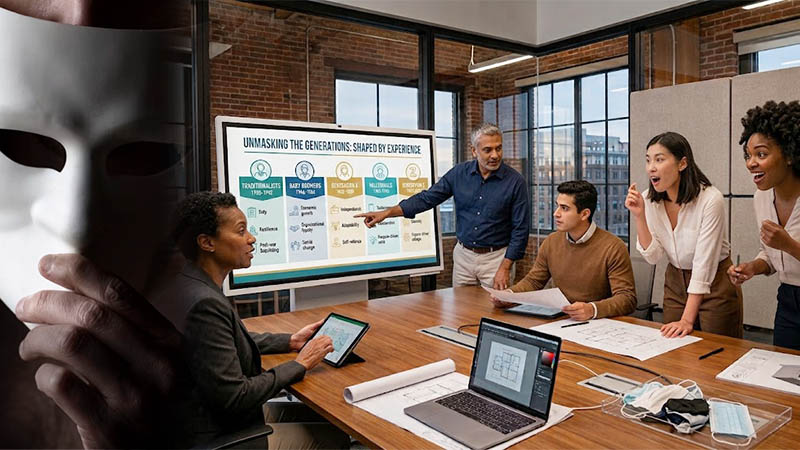
Understanding historical perspectives is essential for cross-generational alignment. Every generation brings distinct worldviews forged by the economic and technological landscape of their formative years.
Traditionalists (1928-1945)
Traditionalists built their professional identities around civic duty, resilience, and post-war economic reconstruction. They respect organizational hierarchy, value long-term stability, and carry foundational operational memory.
Baby Boomers (1946-1964)
Baby Boomers entered the workforce during massive economic expansion, corporate loyalty trends, and cultural transformation. They value dedicated face-to-face communication, structured career ladders, and deep industry connections.
Generation X (1965-1980)
Generation X developed sharp self-reliance, practical adaptability, and an independent work style during shifting economic tides. They bridge analog systems and early digital workflows with pragmatic problem-solving skills.
Millennials (1981-1996)
Millennials scaled the internet, pioneered agile workflows, and elevated purpose-driven business missions. They expect seamless digital tools, collaborative management styles, and transparent paths to career progression.
Generation Z (1997-2012)
Generation Z entered a hyper-connected global market defined by rapid change, automation, and social accountability. They excel at real-time digital problem solving, demand inclusive environments, and expect immediate feedback.
Strategic Benefits of Cross-Age Leadership
Investing in cross-generational teamwork delivers measurable business advantages that solo demographic teams cannot match. Modern leadership requires five core pillars: continuous learning, mutual recognition, career growth, employee empowerment, and deliberate collaboration.
- Preserve Institutional Knowledge: Experienced professionals transfer historical insights and regulatory understanding to newer team members before retirement.
- Accelerate Innovation: Senior operational experience pairs with modern digital fluency to build market-ready products faster.
- Strengthen Leadership Succession: Junior employees gain early visibility into executive decision-making, cutting leadership ramp-up time.
- Build Inclusive Cultures: Employees across all age groups feel seen, appreciated, and motivated to share ideas without hesitation.
- Prepare for Future Disruption: Blended teams combine historical pattern recognition with modern technical agility to navigate sudden industry shifts.
For broader perspectives on demographic shifts, consult the U.S. Bureau of Labor Statistics Employment Projections.
How to Build a High-Trust, Multi-Generational Culture
Leaders must build intentional systems to transform age diversity into operational velocity.
- Establish two-way mentoring programs where junior workers share modern tool stacks while senior peers provide relationship-building strategies.
- Standardize core communication channels so critical decisions do not get lost between emails, direct messages, and verbal meetings.
- Tie quarterly performance incentives to collaborative outcomes rather than isolated departmental achievements.
- Solicit continuous feedback through regular pulses to identify cultural friction before it impacts productivity.


#WorkplaceCulture #LeadershipDevelopment #FutureOfWork