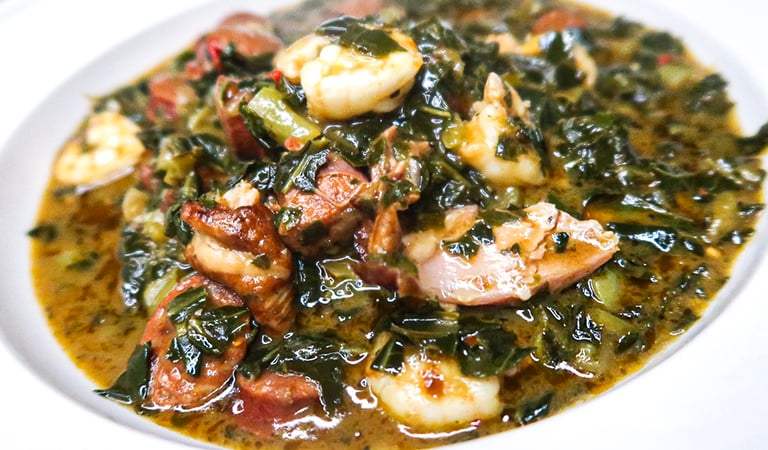

Green Gumbo—traditionally known as gumbo z’herbes or gumbo des herbes—is one of Louisiana Creole culture’s most culturally significant culinary traditions. Traditionally prepared for Holy Thursday before Easter, this nutrient-rich stew combines an odd number of leafy greens (such as mustard, collard, turnip greens, and spinach) with African, Native American, and European culinary techniques. Made famous by legendary New Orleans chef Leah Chase at Dooky Chase’s Restaurant, the dish symbolizes community, spiritual renewal, and resilience, evolving over centuries from a Lenten Lenten-friendly meatless meal into a celebrated fine-dining masterpiece.

Why Green Gumbo Is One Of The Most Meaningful Dishes In Creole Culture
Discover the rich history and cultural significance of Green Gumbo, a traditional dish in Creole culture that holds a special place in their heritage.
A Louisiana Creole Classic Chock Full of Greens
Once a year, on the Thursday before Easter, New Orleanians gather at a legendary spot. Catholics know this day as Holy Thursday. People meet to eat one of the most meaningful dishes in Louisiana Creole culture: gumbo z’herbes.
Dooky Chase’s Restaurant has been serving the dish on Holy Thursday for decades. Emily and Edgar “Dooky” Chase, Sr. started the site as a simple sandwich shop in 1941. Today, the restaurant plans for its usual large crowds every spring. Hopeful diners often call well in advance just to add their names to the waiting list.
The restaurant’s rendition is called gumbo des herbes. Many culinary experts regard it as the ultimate version. The late, great chef Leah Chase, known as the “queen of Creole cuisine,” created this celebrated recipe.
Together with her husband, Edgar “Dooky” Chase, Jr., she transformed the original sandwich shop into a fine-dining establishment. It quickly became a center for the city’s arts community. Furthermore, the restaurant served as an important meeting place for civil rights leaders during the 1960s. Today, Leah Chase’s signature red chef’s jacket hangs in the Smithsonian. She also received the James Beard Foundation’s Lifetime Achievement Award in 2016.
Roots, Spiritual Meaning, and Cultural Heritage

Green gumbo features a blend of various leafy greens. Traditionally, chefs choose an odd number of green varieties—such as mustard greens, collard greens, turnip greens, spinach, and parsley. Creole folklore suggests that eating green gumbo on Holy Thursday brings good luck and financial prosperity. Specifically, tradition holds that for every green variety included in the pot, you will gain a new friend in the coming year.
Beyond culinary tradition, the dish reflects deep resilience. Historical roots trace back to West African, French, and Native American influences. During Lenten fasting periods when meat was restricted, cooks turned to wild greens to build rich, nourishing pots of stew.
Over time, variations expanded to include cured meats, sausage, and brisket after the Lenten fast concluded. Whether prepared as a vegetarian feast or packed with savory smoked meats, green gumbo remains a vital symbol of family, community heritage, and cultural identity in New Orleans.
Don’t feel like washing, trimming and chopping a giant mountain of greens? You can head to Restaurant Beatrice in Oak Cliff — one of only a couple of restaurants outside of Louisiana I’ve found that’s serving the dish this season. (The other is The Gumbo Bros. in Nashville, Tenn.)
At Beatrice, executive chef-owner Michelle Carpenter and executive chef Terance Jenkins are featuring two renditions on their current menu: Leah Chase’s Gumbo Z’Herbes and Vegan Green Gumbo.
“Gumbo Z’Herbes has a history and significance much greater than Restaurant Beatrice,” says Carpenter. “We are only 10 months old. The history of enslaved folks in Louisiana spans 300 centuries.”
She and Jenkins are featuring green gumbo because, she says, “We wanted to pay tribute and honor the faces who have shaped this dish, and we wanted to insert ourselves into the canon and legacy of Cajun and Creole foods. … This dish is about the history of Louisiana, and our vegan interpretation is one way for us to look at our shared future.”
Former Dallas Morning News restaurant critic Leslie Brenner, now a restaurant consultant with Leslie Brenner Concepts, writes about cooking at Cooks Without Borders.
‘JUBILEE’ GUMBO Z’HERBES
1 1/2 pound collard greens, washed, stemmed and coarsely chopped
2 1/2 pounds greens (such as mustard, turnip greens, watercress, kale, chard, beet and carrot tops, spinach), washed, stemmed and coarsely chopped
1/4 head cabbage, coarsely chopped
1 tablespoon plus 1 3/4 teaspoons salt, plus more to taste
1/2 pound beef brisket, cut into 1/4-inch dice
3/4 teaspoon freshly ground black pepper, plus more to taste
2 tablespoons bacon drippings or vegetable oil
1/2 pound smoked andouille sausage, sliced into thick coins
1/2 pound ham, cut into 1/4-inch dice
2 cups chopped onions
1/2 cup sliced scallions
1 cup chopped green bell pepper
1 1/2 cups chopped celery
1 tablespoon minced jalapeño or serrano chile
1 tablespoon minced garlic (2 to 3 cloves)
1 teaspoon dried thyme
1/4 teaspoon cayenne pepper
2 bay leaves
1 quart chicken broth
2 tablespoons chopped parsley
1 tablespoon fresh thyme leaves
Cooked rice, for serving
In a very large Dutch oven or heavy soup pot, combine the collards and 6 1/2 cups water. Bring to a boil, then reduce the heat to medium and simmer until the collards are tender, about 30 minutes. Add the greens, cabbage and 1 tablespoon salt to the pot. Return to a boil, then reduce the heat to a gentle simmer and cook, covered, until the greens are very tender. (Depending on the greens you use, this could be more than an hour.) Making sure to reserve the cooking liquid (the “potlikker”), drain the greens in a colander, then coarsely chop them.
Measure the potlikker — you’ll need two cups. (If you have extra, reserve it for another use.) If you don’t have enough, add water to yield two cups. Set aside.
Season the brisket with 1/2 teaspoon of the salt and 1/4 teaspoon of the black pepper. In a large skillet, heat the bacon fat or vegetable oil over medium-high heat. Add the brisket, andouille sausage and ham and cook for 10 minutes, stirring occasionally, to render the fat and brown the meats. Stir in the onions, scallions, bell pepper, celery, jalapeño or serrano and garlic and sauté until the vegetables are tender-crisp, 3 to 5 minutes. Stir in the dried thyme, 1 1/4 teaspoon of the salt, 1/2 teaspoon of the black pepper and the cayenne, and cook until fragrant, 2 to 3 minutes longer.
In the Dutch oven or soup pot, combine the cooked greens, the reserved 2 cups of potlikker and the browned meat and vegetables. Cook for 15 minutes to concentrate the flavors. Stir in the bay leaves and chicken broth. Bring to a boil, then reduce the heat to medium-low, and cook until the meats are tender, about 45 minutes. Remove and discard the bay leaves, taste and adjust the seasoning. Stir in the parsley and fresh thyme. Serve over hot cooked rice.
Serves 10 to 12.
Source: “Jubilee: Recipes from Two Centuries of African American Cooking” by Toni Tipton-Martin
#CreoleCulture #GreenGumbo #FoodHeritage #CreoleCuisine #GumboZHerbes