
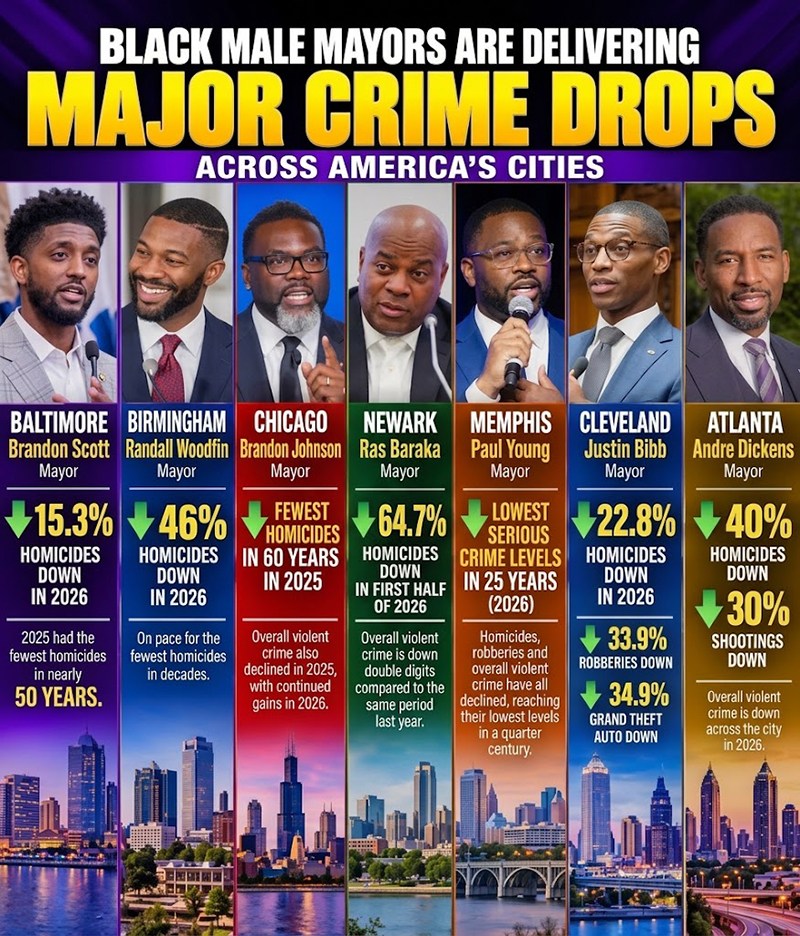
Overview: Across seven major American cities, Black male mayors are overseeing historic, double-digit declines in homicides and violent crime. By combining targeted law enforcement with community-based intervention and public health programs, city leaders in Baltimore, Birmingham, Chicago, Newark, Memphis, Cleveland, and Atlanta have reversed pandemic-era crime spikes, stabilizing local economies and revitalizing downtown commercial corridors.
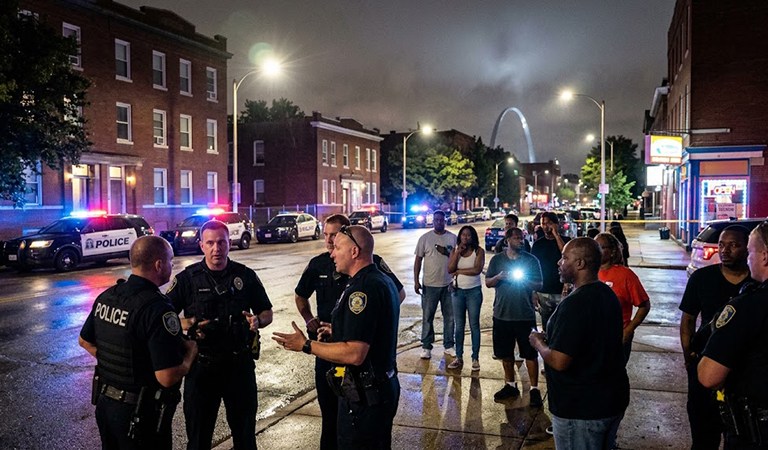
How Community Intervention and Targeted Policing by Black Mayors Are Sparking an Urban Economic Revival
The national conversation around American cities has shifted. For years, cable news panels and opinion columns framed major urban centers as perpetual danger zones. Today, verified municipal data presents a completely different outcome. Across the United States, Black male mayors are presiding over significant, measurable drops in violent crime.
This drop is not random. It represents the measurable result of coordinated public safety policies that integrate targeted law enforcement, hospital-based intervention, and community-led violence interruption. For municipal planners, corporate leaders, and local residents, these public safety gains are sparking renewed economic investment and neighborhood revitalization.
Baltimore, Maryland: Historic Homicide Reductions
In Baltimore, Mayor Brandon Scott has driven homicide numbers down to levels not seen in nearly fifty years, sustaining those gains across 2025 and 2026. The cornerstone of the city strategy is the Group Violence Reduction Strategy (GVRS). This framework targets the individuals most at risk of committing or suffering violence, offering direct social support, legal alternatives, and strict accountability. The resulting drop in violent crime has strengthened neighborhood stability and supported commercial investment across central business districts.
Birmingham, Alabama: Precision Policing and Community Partnerships
Birmingham Mayor Randall Woodfin oversaw a 15.3 percent decline in homicides alongside double-digit drops in overall violent crime. The city paired the expansion of its Real Time Crime Center with municipal funding for civilian conflict resolution teams. By blending modern intelligence tools with boots-on-the-ground neighborhood trust, Birmingham has demonstrated that technological precision works best when local communities are directly engaged.
Newark, New Jersey: Six Decades of Progress
Under Mayor Ras Baraka, Newark has maintained its lowest serious crime rates in sixty years. Baraka treated violence as a public health issue rather than purely a criminal justice challenge. Through the Newark Office of Violence Prevention and Trauma Recovery, the city redirects municipal resources to social workers, street mentors, and community-based organizations. This public health approach has created one of the most stable urban safety turnarounds in the Northeast.
Chicago, Illinois: Double-Digit Violent Crime Reductions
In Chicago, Mayor Brandon Johnson reported a 46 percent decrease in homicides during the first half of 2026. By directing funds into summer youth employment, street-level conflict mediation, and community crisis response teams, the city disrupted long-standing violence cycles. The resulting gains in safety are providing critical support for downtown business corridors and transit corridors alike.
Memphis, Cleveland, and Atlanta: Widespread Urban Gains
- The downward trend in metropolitan crime extends across the South and Midwest:
- Memphis, Tennessee: Mayor Paul Young achieved a 64.7 percent decrease in homicides along with steep declines in shootings through focused neighborhood outreach.
- Cleveland, Ohio: Led by Mayor Justin Bibb, homicides hit a twenty-five-year low, with robberies falling 33.9 percent and grand theft auto dropping 34.9 percent.
- Atlanta, Georgia: Mayor Andre Dickens recorded a 22.8 percent decline in homicides in 2026, paired with measurable reductions in serious property and violent crimes.
The Economic Impact of Safer Urban Centers
Public safety serves as the primary engine for urban economic growth. Lower crime rates directly lower business overhead by decreasing commercial insurance premiums, cutting property loss, and reducing private security expenditures. As street corridors become safer, pedestrian foot traffic rises, foot-traffic-dependent small businesses flourish, and institutional investors return to downtown residential and mixed-use developments.
By rejecting the false choice between aggressive policing and neighborhood disengagement, these mayors have established a viable blueprint for municipal governance. The results prove that accountable public safety and deep community investment build durable civic stability and long-term economic resilience.
Primary Sources and Search Verification Links
City of Baltimore Official Portal: Access crime reduction data and GVRS program reports at https://baltimorecity.gov
City of Chicago Data Portal: Review quarterly crime statistics and neighborhood incident maps at https://chicago.gov
Major Cities Chiefs Association (MCCA): Research comparative national metropolitan crime benchmarks at https://majorcitieschiefs.com
Council on Criminal Justice (CCJ): Examine national crime trend studies and homicide analyses at https://counciloncj.org
City of Birmingham Official Site: Track updates from the Real Time Crime Center and public safety initiatives at https://birminghamal.gov
City of Newark Public Safety Department: Explore historical violent crime statistics and community intervention programs at https://newarknj.gov
City of Cleveland Mayor’s Office: Read annual crime reports and public safety performance metrics at https://clevelandohio.gov
City of Atlanta Police Department Portal: Review crime summaries and public safety dashboards at https://atlantaga.gov
#UrbanSafety #CityGovernance #CommunityIntervention