


Overview: Gout impacts Black men at significantly higher rates than white men, yet one in three affected individuals does not know it can be managed and controlled. The Arthritis Foundation tackled this health disparity by bypassing typical clinical settings to meet more than 22,000 men in barbershops, churches, and community spaces. By replacing clinical lectures with interactive tools and practical doctor discussion guides, the initiative connects patients with urate-lowering care to halt chronic joint damage before mobility is permanently lost.
From Awareness to Action: Meeting African American Men Where They Gather to Confront Gout and Close the Joint Health Gap
We Asked 22,000 Black Men About Joint Pain. One Shocking Answer Changed Everything.
From Awareness to Action: How Meeting Men Where They Gather Is Rewriting Gout Care
You cannot fix a health crisis from behind a desk or inside an academic bubble. If you want people to listen, you have to show up where life actually happens: community centers, barbershops, church basements, and health fairs.
That fundamental insight drove the first year of our multi-year initiative at the Arthritis Foundation. Rather than trying to boil the ocean, we made a strategic choice. We picked one condition, partnered with one specific community, and built a measurable, street-level playbook.
Our focus for Year One: gout among African American men.
The Problem We Refused to Walk Past
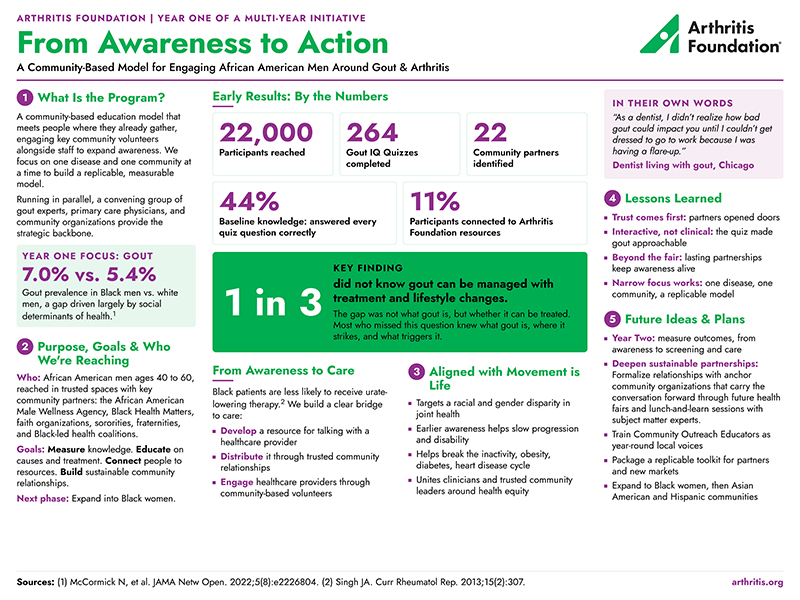
Gout is often treated like a punchline, a relic of medieval diets, or a temporary nuisance. The reality on the ground is brutally different. Gout is an inflammatory arthritis that hits African American men at significantly higher rates than white men (7.0% compared to 5.4%).
That gap has little to do with personal failing and everything to do with social determinants of health, unequal access to treatment, and persistent clinical blind spots.
Even worse, Black patients living with gout are systematically less likely to be prescribed standard urate-lowering therapies. When pain spikes, men are left to suffer in silence or push through agonizing flare-ups that take them away from their jobs, their families, and their daily routines.
A practicing dentist in Chicago shared his reality with us: “I didn’t realize how bad gout could impact you until I couldn’t get dressed to go to work because I was having a flare-up.” When a medical professional cannot put on socks or hold tools due to sudden swelling, imagine what happens to people without flexible jobs or gold-plated health plans.
Finding the Real Gap
Working shoulder to shoulder with trusted groups like the African American Male Wellness Agency, Black Health Matters, local fraternities, and faith coalitions, our teams engaged men between the ages of 40 and 60. We did not lecture them. We invited them to test what they knew through our Gout IQ Quiz.
The initiative directly reached over 22,000 participants and secured hundreds of detailed quiz responses. The baseline numbers were eye-opening:
44 percent of participants had strong baseline awareness, answering every foundational question correctly.
The men generally understood what gout was, how it felt, and what triggers caused flare-ups.
One in three participants had no idea that gout can be actively managed, controlled, and prevented with long-term treatment and targeted lifestyle shifts.
The issue was never awareness of the pain. The real barrier was a total lack of awareness about the cure. Men assumed agony was simply the cost of getting older, an unavoidable sentence they just had to endure.
From Street Fairs to Clinical Care
Knowing that gout is treatable is only half the battle. Getting a prescription and regular monitoring is the finish line.
To bridge that divide, we developed practical tools to help men talk directly with their doctors about uric acid levels. We distributed these conversation guides through the local leaders and volunteers who already had their ear.
This work runs hand-in-hand with the national Movement is Life framework. When you stop joint damage early, you keep men moving. Keeping men moving breaks the brutal cycle where joint pain leads to physical inactivity, which then fuels obesity, diabetes, and cardiovascular complications. Protecting joints protects lives.
What Year One Taught Us
Building programs that actually move the needle requires discipline:
- Trust opens doors that credentials cannot. Community leaders, sororities, and local advocates gave this work credibility long before a doctor took the microphone.
- Interactive beats clinical every time. A fast, low-friction quiz got men talking openly about their joints without feeling judged.
- Events end, but partnerships endure. Handing out flyers for a weekend achieves nothing. Aligning with anchor institutions builds a sustainable presence that lasts year-round.
- Focus creates scale. Mastering one disease inside one community generated a clean, repeatable engine that can now be rolled out across the country.
The Road Ahead
Year One proved the concept. Year Two is about scaling the footprint and measuring long-term patient outcomes.
We are formalizing deeper partnerships with local organizations to host routine lunch-and-learns, training Community Outreach Educators to serve as permanent local champions, and packaging our field assets into a plug-and-play toolkit.
From here, we are expanding our outreach to Black women, who face their own unique hurdles with joint health, followed by targeted initiatives for Asian American and Hispanic communities.
When you strip away clinical jargon, respect cultural trust, and hand people practical answers, awareness turns into real action. That is how health equity stops being a buzzword and starts changing lives.
#GoutAwareness #MensHealth #HealthEquity