
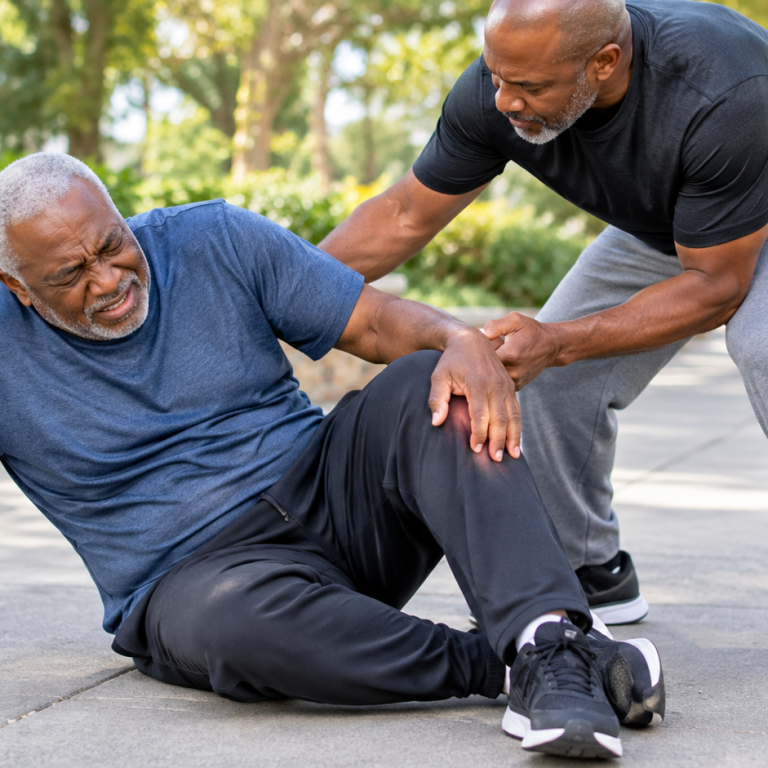
I was expecting my nephew to come over to my apartment to take a look at my stalled vehicle. Instead, I found myself rushing to his side after he fell in the parking garage of his apartment building. Luckily, he had his phone with him and was able to call me for help. At 50 years old and a bit overweight, he often complained about his bad knees, so I suspected that might have been the cause of his fall.
I helped him back to his apartment and sat him down, and that’s when we discovered he had torn a ligament in his left knee. The pain was intense, so I called an ambulance, and he was taken to the nearest hospital in St. Louis. An X-ray confirmed the torn ligament. I felt sad for him, especially since his daughter was getting married in just three days.
This incident happened shortly after my best friend’s wife, who was 62, had to undergo knee replacement surgery. I felt for him too, knowing that his wife was quite a control freak—she always expected him home by 9 p.m., and she would kick him out if he drank too much during our boys’ night out. All of this made me wonder—what’s really going on with our knees?
I realize I’m not exempt from knee issues myself. Writing this has prompted me to reflect on my own steps and consider how I can take better care of my health.
Let’s see what the experts are saying, I did a little research and got some insight from the CDC.
Why Do Older Adults Fall So Easily—and What Happens When the Knee Is Injured?
A fall can happen in seconds, but for an older adult, the consequences can last for months. As people get older, changes in muscle strength, balance, eyesight, reflexes, joints and medications can make it harder to recover from a stumble or avoid a fall altogether.
According to the Centers for Disease Control and Prevention (CDC), falls are not simply an unavoidable part of aging. However, the risk increases as people grow older. In 2024, falls among adults age 65 and older resulted in approximately 4.5 million emergency-department visits in the United States and more than 43,000 deaths.
Why do older people fall?
There is rarely just one reason.
The National Institute on Aging says aging can bring declines in muscle mass and strength, balance, vision, hearing and reflexes. Conditions involving the heart, nerves, feet, blood vessels or thyroid can also affect balance. Some medications can cause dizziness, drowsiness or confusion. Even standing up too quickly can cause a temporary drop in blood pressure and make someone unsteady.
The CDC identifies several additional fall-risk factors, including lower-body weakness, difficulty walking, poor vision, foot problems, certain medications and hazards such as loose rugs, clutter and poor lighting.
Women can face particular concerns as they age. Research cited by the CDC has found that older women have reported falls and fall-related injuries at higher rates than men. Aging and female sex are associated with reduced muscle mass, while knee osteoarthritis is also more common among women.
Does being over 50 mean you will need knee surgery?
No. Turning 50, 60 or even 70 does not automatically mean a person needs a knee replacement.
One major reason knee replacements become more common with age is osteoarthritis. Over time, the cartilage covering the ends of the bones can deteriorate. As cartilage is lost, the joint can become painful, stiff and difficult to move.
The American Academy of Orthopaedic Surgeons (AAOS) notes that knee osteoarthritis becomes more common after age 50. Risk factors include age, previous knee injury, genetics, excess weight and sex, with women more likely than men to develop knee osteoarthritis.
For many patients, doctors initially recommend nonsurgical approaches such as exercise, physical therapy, weight management when appropriate, medications or other treatments. Knee replacement is generally considered when pain and loss of function remain significant despite conservative treatment.
What types of knee surgery are available?
“Knee surgery” can mean several very different procedures.
Arthroscopy uses small incisions and a camera to examine or treat certain problems inside the joint.
Meniscus surgery may involve repairing or trimming damaged cartilage.
Ligament reconstruction may be performed when a ligament such as the ACL has been seriously damaged and the knee is unstable.
Partial knee replacement replaces only the damaged compartment of the knee.
Total knee replacement replaces the damaged joint surfaces with prosthetic components. It is one of the most common operations for advanced knee osteoarthritis.
There are also revision knee replacements, which are operations performed when a previous knee replacement develops a problem and requires replacement or repair.
How easy is it to tear a knee ligament?
A ligament is a strong band of tissue that connects bones and helps stabilize a joint. The knee has four major ligaments: the ACL, PCL, MCL and LCL.
Ligament injuries can happen from sports, twisting, sudden changes in direction, falls or other forces placed on the knee. The ACL is particularly vulnerable to twisting and sudden movements. AAOS notes that ACL injuries can occur with or without contact.
But not every fall tears a ligament.
A person may suffer a sprain, partial tear or complete tear. The seriousness of the injury depends on which ligament is involved, how badly it is damaged and whether other structures—including the meniscus or cartilage—are injured.
Age can also change the picture. An older person may have arthritis or weakened tissues in the knee before the fall occurs, meaning an accident that might produce a relatively minor injury in one person could cause a more complicated injury in another.
How long does a torn knee ligament take to heal?
There is no single recovery time.
Some ligament injuries can be treated without surgery using rest, physical therapy, bracing and gradual rehabilitation. More serious injuries may require reconstruction.
For ACL reconstruction, AAOS patient guidance says recovery from surgery commonly ranges from six to 12 months, depending on the individual. Physical therapy is an important part of rehabilitation because the knee must regain strength, balance, coordination and function.
That does not mean every person with an ACL injury needs surgery. Treatment depends on factors such as the patient’s age, activity level, knee stability, associated injuries and overall health.
What about knee replacement recovery?
Knee replacement recovery also varies from person to person.
Many patients begin walking and physical therapy very soon after surgery. Early rehabilitation focuses on controlling swelling and pain, restoring movement and gradually rebuilding strength. Recovery continues for weeks and months rather than ending when the surgical incision heals.
A patient’s age, muscle strength, general health, activity level and commitment to rehabilitation can all influence recovery.
The key point is that surgery is only one part of the journey. Physical therapy and safe movement afterward are critical to regaining function.
Protecting the knees—and preventing the fall
The best knee injury may be the one that never happens.
The CDC and National Institute on Aging recommend strategies such as strength and balance exercises, medication reviews, regular vision checks, proper footwear and removing household hazards.
Older adults should also tell their healthcare provider if they have fallen, feel unsteady or are afraid of falling. A fall can sometimes be an early warning sign of a correctable problem involving medications, vision, balance, blood pressure or muscle weakness.
Aging does not automatically mean bad knees, frequent falls or surgery. But aging can create a combination of changes that makes falls and joint injuries more likely. Understanding those risks—and addressing them early—can help older adults remain mobile, independent and active for many years.
Take care out there and stay safe….